Soup for a Crowd: Scaling, Holding Hot and Serving Thirty
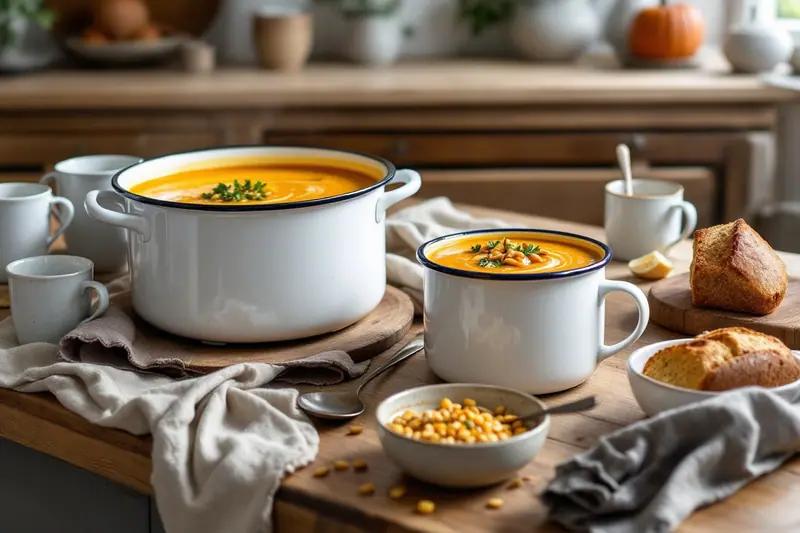
Early February is the heart of soup season here. The snow has settled into its long gray middle, the root cellar is down to squash and onions and the last bin of apples, and every church hall, ski lodge and town meeting seems to want a pot of something hot. Cooking soup for thirty is not hard, but it is not the same as cooking soup for six multiplied by five. The pot behaves differently, the seasoning drifts, and the hardest part turns out to be keeping it hot and then cooling what is left over.
What follows is what I have learned from making soup in big batches for suppers and open houses, and a recipe for a butternut and apple soup that holds well for hours and tastes even better the next day.
How much soup to make
The amount depends on what else is on the table.
| Role of the soup | Per person | For 30 guests |
|---|---|---|
| A cup alongside other food | 1 cup (8 fl oz) | 7 1/2 quarts |
| A bowl as part of a soup and bread supper | 1 1/2 cups | 11 1/4 quarts |
| The main event, with seconds | 2 cups | 15 quarts |
When I offer two soups at a supper, I make each at about two thirds of the single-soup amount, since most people try both. A pot of 10 quarts of each serves 30 hungry people comfortably. The guide to how much food per guest has the bread and salad numbers if you are building a whole menu around it.
Scaling a recipe without losing it
Most soup recipes double well. Past doubling, a few things start to change, and it helps to know which.
Vegetables and liquid scale straight
If the recipe for 6 uses 3 pounds of squash and 6 cups of stock, the recipe for 30 uses 15 pounds and 30 cups. No surprises here.
Salt does not
A big pot loses less liquid to evaporation in proportion to its volume, so a soup that was seasoned perfectly in a small pot can taste oversalted at five times the size. I add about two thirds of the scaled salt at the start and finish seasoning at the end, a teaspoon at a time, stirring well and tasting from the middle of the pot.
Spices and garlic go in at about three quarters
Ground spices, chili, ginger and garlic seem to intensify in a big batch as it sits. You can always add more. You cannot take any out.
Cooking time grows
A big pot takes longer to come to a simmer, and the vegetables in it take longer to soften. Plan on half again as long for the simmer, and check by tasting a piece from the bottom of the pot.
Thickness drifts
Pureed soups thicken as they stand, especially those with squash, potato, beans or lentils. Make the soup slightly thinner than you want it and keep a quart or two of hot stock on the back of the stove for thinning through the evening.
Pot sizes
A full pot is hard to stir and harder to lift, and soup near the brim scorches at the bottom before the top is hot. Fill no more than three quarters of the way up.
| Pot | Usable volume | Cups of soup |
|---|---|---|
| 8-quart stockpot | about 6 quarts | 24 cups |
| 12-quart stockpot | about 9 quarts | 36 cups |
| 16-quart stockpot | about 12 quarts | 48 cups |
| 20-quart stockpot | about 15 quarts | 60 cups |
For 30 servings of a cup and a half, a 16-quart pot does it in one batch, or two 8-quart pots side by side. Two pots are easier to manage on a home stove because they fit over two burners and heat faster. A heavy bottom matters more than size. Thin pots scorch.
For pureeing, an immersion blender is the only sensible tool at this volume. Ladling 12 quarts of hot soup into a countertop blender is how people burn themselves.
Holding it hot
Hot soup needs to stay at 140°F (60°C) or above for as long as it is out. Bring it to a full simmer on the stove first, at least 165°F (74°C), and then move it to whatever will hold it. Holding equipment is good at keeping soup hot. It is slow and uneven at heating cold soup, and soup that climbs slowly through the middle temperatures is exactly what you want to avoid.
Slow cookers
A 6-quart slow cooker holds about 5 quarts, or 20 cups, of soup when full. Set it on low or warm once the hot soup is in, and stir it every half hour, since the soup near the walls gets hotter than the center. Two or three slow cookers on a buffet line let you offer more than one kind and spread the crowd out.
Electric roasters
An 18-quart electric roaster oven holds 12 to 14 quarts of soup, enough for a whole supper. Set it to about 200°F (93°C), which keeps soup steaming without boiling it, and keep the lid on between servings. A roaster is the workhorse of every church hall kitchen I have ever cooked in.
On the stove
If the kitchen is next to the serving table, the simplest arrangement is to keep the pot on the lowest burner with a heat diffuser underneath, and carry it out in smaller amounts.
Whatever you use, a probe thermometer clipped to the side of the pot saves guessing. The guide to keeping party food safe covers the holding rules for a whole buffet.
Seasoning at the end
Taste the soup three times: after pureeing, after it has held for half an hour, and just before serving. Use a clean spoon each time and take the taste from the middle of the pot, not the surface, where the soup has thickened and concentrated. Soups dull as they sit, and a soup that was lively at four o'clock can taste tired by seven. Salt is the first fix, then acid. A splash of cider vinegar or lemon juice brightens a squash soup more than another spoonful of spice ever will. If the soup tastes flat and salty at the same time, it needs acid, not more salt.
The serving station
Set the soup at the end of the buffet, after the bread, so people are not juggling a full mug while they try to butter a roll. The guide to setting up a buffet table has more on the order of dishes.
- An 8-ounce ladle, so one scoop is one serving.
- Mugs for a standing crowd, bowls for a seated one. Mugs are easier to carry and harder to spill.
- A small plate or saucer under the pot to catch drips.
- Garnishes in small bowls: toasted pumpkin seeds, a little sour cream or yogurt thinned with lemon, chopped chives.
- A sign or card with the name of the soup and whether it contains dairy.
- Bread on a board next to it. A brown Irish soda bread is my choice with a squash soup.
The recipe
From the recipe box
Butternut and apple soup for thirty
About 11 quarts, 30 servings of 1 1/2 cups
- Prep
- 1 hr
- Cook
- 1 hr 45 min
- Total
- 2 hr 45 min
Soup
- 15 lb6.8 kg butternut squash (about 6 medium), peeled, seeded and cut into 1 inch cubes
- 4 lb1.8 kg tart apples (about 9), peeled, cored and chopped
- 1 1/2 sticks170 g unsalted butter
- 4 large4 large yellow onions, chopped
- 44 celery ribs, chopped
- 88 garlic cloves, sliced
- 2 tbsp30 ml grated fresh ginger
- 1 tbsp15 ml ground coriander
- 1 tsp5 ml freshly grated nutmeg
- 6 quarts5.7 l vegetable or chicken stock, plus 2 quarts for thinning
- 2 cups480 ml apple cider
- 2 tbsp30 ml kosher salt, plus more to taste
- 1 1/2 cups360 ml heavy cream (optional)
- 3 tbsp45 ml cider vinegar
Method
- Melt the butter in a 16-quart pot (or divide everything between two 8-quart pots) over medium heat.
- Add the onions and celery and cook, stirring often, until soft and translucent but not browned, about 15 minutes.
- Stir in the garlic, ginger, coriander and nutmeg and cook 2 minutes, until fragrant.
- Add the squash, apples, 6 quarts stock, cider and 2 tablespoons salt. The liquid should just cover the vegetables; add a little more stock if it does not.
- Bring to a boil over high heat, which takes 25 to 30 minutes at this volume, then lower to a steady simmer.
- Simmer uncovered, stirring the bottom every 10 minutes, until the squash crushes easily against the side of the pot, 40 to 50 minutes.
- Take the pot off the heat and puree with an immersion blender until completely smooth, keeping the blade below the surface.
- Stir in the cream, if using, and the vinegar. Thin with hot stock until the soup coats a spoon but pours easily.
- Taste from the middle of the pot and add salt a teaspoon at a time. Bring back to a simmer, at least 165°F (74°C), before moving to a slow cooker or roaster.
Notes from the kitchen
- Leave out the cream for a dairy-free soup; it is just as good with a spoonful of thinned yogurt on the side.
- The soup can be made two days ahead and refrigerated, then reheated on the stove to 165°F (74°C).
Cooling leftovers safely
A big pot of soup is the classic trap. It holds heat for hours, and a 12-quart pot set in the refrigerator can stay warm in the middle overnight. The rule is to bring soup from 140°F (60°C) down to 70°F (21°C) within two hours, and then to 40°F (4°C) or below within four more.
- Turn off the heat as soon as service ends. Do not let the pot sit on warm.
- Divide the soup into shallow containers, no more than 2 to 3 inches deep. Quart deli containers and hotel pans work well.
- For a faster start, set the pot in a sink full of ice water and stir it for 10 to 15 minutes before dividing. Change the ice once it melts. A frozen gallon jug of water, scrubbed clean and set right in the soup, does the same job and takes up less room.
- Refrigerate uncovered until cold, then cover and label with the date.
- Use within 3 to 4 days, or freeze. Squash soup freezes well for 2 to 3 months; add the cream after thawing if you plan to freeze it.
Questions from hosts
Can I make the soup a day ahead?
Yes, and for squash soups it is better that way. Cool it properly, then reheat on the stove the day of, stirring often, before it goes into the holding pots.
My soup got too thick in the slow cooker. What now?
Stir in hot stock, a cup at a time, and taste again. Cold liquid drops the temperature, so keep the thinning stock warm.
How many people can one roaster serve?
An 18-quart roaster with 13 quarts of soup serves about 35 at a cup and a half, or about 50 at a cup.
When the last mug comes back, scrape the pot while it is still warm. Cold squash soup on a stockpot wall sets like plaster.
Topics: Soups & Salads | Kitchen Craft

Nell keeps a big vegetable garden in southern Vermont and cooks from it most of the year. She writes about soups, salads, maple and the seasonal table.