Holiday Cookie Swap: Rules, Counts and Cookies That Travel
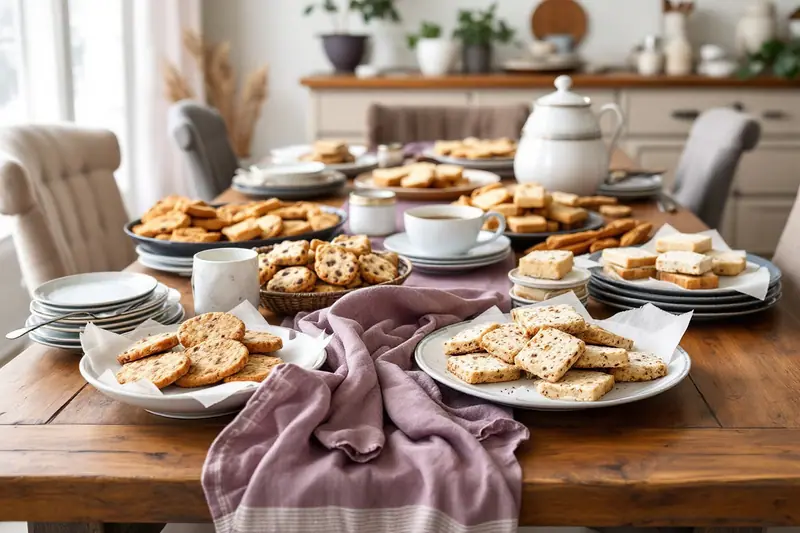
A cookie swap is the most efficient holiday baking there is. You bake one kind of cookie in quantity, you come home with eight or ten kinds, and you spend an afternoon in a warm room with people who also think brown butter is worth the extra pan. The whole idea falls apart, though, when the rules are vague. One person brings two dozen cookies for twelve bakers, someone else brings a cream pie, and a tray of meringues arrives in a damp heap.
With Thanksgiving dishes still drying in the rack, this is the week to send the invitations. Most people's December calendars fill up fast, and bakers need about two weeks' notice to plan a big batch. Here is how I set one up, with the numbers worked out and a recipe for a spice cookie that will survive any car ride.
Set the date and the guest list
The best swaps happen in the first two weeks of December, early enough that the cookies can go into tins for the holidays or into the freezer. A Saturday or Sunday afternoon, from 2:00 to 4:30, gives people time to bake the night before and still makes it home before dark.
Eight to twelve bakers is the right size. With fewer than eight the variety is thin; with more than twelve the counting gets out of hand and the table runs out of space. If more people want to come, have them bring a friend and a smaller batch, or split into two swaps on different weekends.
The rules, written down
Put these in the invitation so nobody has to guess.
- One kind of cookie per baker. Ask people to reply with what they are bringing so you don't end up with four batches of chocolate chip.
- Homemade only. That is the whole point.
- Cookies that keep at room temperature for at least five days. No cream fillings, no custards, nothing that needs refrigeration.
- Bring a set number, worked out below, plus half a dozen extra for tasting.
- Bring a container to take your share home: a tin, a box or a large lidded container.
- Bring a recipe card, or a dozen copies of one. People always ask.
- Label anything with nuts. A small card next to the plate is enough, and it matters to the guests who have to check.
How many cookies per person
This is the part people get wrong. The rule I use: each baker brings six cookies for every baker in the group, counting themselves, plus six more for tasting at the party. Everyone goes home with a half dozen of each kind.
| Bakers | Each baker brings | Each baker takes home | Total on the table |
|---|---|---|---|
| 6 | 42 (3 1/2 dozen) | 36 (3 dozen) | 252 (21 dozen) |
| 8 | 54 (4 1/2 dozen) | 48 (4 dozen) | 432 (36 dozen) |
| 10 | 66 (5 1/2 dozen) | 60 (5 dozen) | 660 (55 dozen) |
| 12 | 78 (6 1/2 dozen) | 72 (6 dozen) | 936 (78 dozen) |
Worked out for ten bakers: 10 times 6 is 60, plus 6 for tasting makes 66 cookies, which is a double batch of most drop-cookie recipes. Each guest goes home with 60 cookies of ten kinds. That is plenty for a household, and it fills two large tins.
Some groups like a full dozen of each kind. That doubles the baking, so it works best with eight bakers or fewer: eight bakers at a dozen each means 96 cookies to take home and 108 to bake.
Whatever you choose, put the number in the invitation so everyone bakes the same amount, and round up rather than down.
Cookies that travel
The best swap cookies are sturdy, dry enough to stack and still good a week later. A quick test: if you could drop one on the counter from six inches and it would survive, it will survive a car trip.
Good travelers
- Molasses spice cookies, like the one below
- Shortbread, plain or with orange zest, cut in squares or fingers
- Biscotti, which get better after a few days
- Butter cookies rolled in sugar, like thumbprints filled with a stiff jam
- Brownie or blondie bars, cut and wrapped individually
- Gingersnaps and thin spice wafers
- Maple sugar cookies, cut out and lightly iced with a glaze that sets hard
Poor travelers
- Meringues, which go soft in humid kitchens
- Cookies with cream cheese frosting or whipped fillings
- Very thin lace cookies, which shatter
- Anything iced with soft buttercream, which smears and sticks to the next layer
- Cookies that need refrigeration
Soft cookies are fine if they are firm enough to stack, but they should cool completely before packing or they steam each other and stick together.
Packaging
The easy way is to bring cookies in a large container lined with parchment, layered with parchment between rows. At the swap, everyone lays out their cookies on the table and fills their own containers.
If you prefer, each baker can pack ready-made bundles: six cookies in a small bag or wrapped in parchment and tied with string, one bundle per guest. This takes more time at home but makes the swap itself fast and tidy. Bags with a flat bottom stand up on the table, which is helpful.
A few habits keep cookies in good shape:
- Pack crisp and soft cookies in separate containers. The crisp ones absorb moisture from the soft ones and go limp.
- Strongly flavored cookies, like peppermint or anise, go in their own tin or bag, or everything else will taste of them.
- Put the heaviest, sturdiest cookies on the bottom.
Running the afternoon
Set up a long table cleared of everything but the cookies. Lay out a plate or tray for each baker, with a card for the cookie's name and a note about nuts or other allergens. Have a few extra boxes and some parchment on hand for the person who forgot.
When everyone has arrived, give people 20 minutes to taste, then start the swap: each person walks around the table and takes their share from each plate. It moves faster if you go in two or three groups. Coffee, tea and one savory thing (a bowl of spiced nuts, a cheese board, a pot of soup in a cold snap) help break up all that sugar.
If there is anything left at the end, send it home with whoever has the most children, or pack it for a neighbor. The cookies do not need to be sorted further.
The spice cookie I bring
This is a molasses spice cookie with crisp edges and a chewy middle, rolled in coarse sugar so the tops crackle. It holds its shape, stacks well, and keeps for a week in a tin or three months in the freezer. The dough can be made three days ahead and refrigerated.
From the recipe box
Sturdy molasses spice cookies
About 40 cookies
- Prep
- 25 min
- Cook
- 22 min
- Rest
- 1 hr
- Total
- 1 hr 47 min
Dough
- 2 1/4 cups280 g all-purpose flour
- 2 tsp10 ml baking soda
- 1/2 tsp2.5 ml fine salt
- 2 tsp10 ml ground ginger
- 1 1/2 tsp7.5 ml ground cinnamon
- 1/2 tsp2.5 ml ground cloves
- 1/4 tsp1.25 ml finely ground black pepper
- 1 1/2 sticks170 g unsalted butter, softened
- 1 cup210 g packed dark brown sugar
- 1 large1 large egg, at room temperature
- 1/4 cup60 ml unsulphured molasses
For rolling
- 1/3 cup65 g coarse sugar or granulated sugar
Method
- Whisk the flour, baking soda, salt, ginger, cinnamon, cloves and pepper together in a bowl.
- Beat the butter and brown sugar with a mixer on medium speed for 3 minutes, until lighter in color and fluffy.
- Beat in the egg, then the molasses, scraping the bowl; the mixture may look a little curdled, which is fine.
- Add the dry ingredients on low speed and mix just until no streaks of flour remain.
- Cover the bowl and refrigerate the dough for at least 1 hour, or up to 3 days.
- Heat the oven to 350°F (175°C) with racks in the upper and lower thirds, and line two sheet pans with parchment.
- Scoop the dough into 1 1/4-inch balls (about 25 g each), roll them in the coarse sugar and set them 2 1/2 inches apart.
- Bake 10 to 11 minutes, switching the pans halfway, until the tops are crackled and the edges are set but the centers still look slightly soft.
- Cool on the pans for 5 minutes, then move to a rack and cool completely before packing.
Notes from the kitchen
- For a crisper cookie that travels even better, bake 13 minutes.
- Freeze the rolled dough balls on a sheet pan, then bag them; bake from frozen, adding 1 to 2 minutes.
- A double batch makes about 80 cookies, enough for a ten-person swap with half a dozen for each guest and extra for tasting.
Baking ahead and freezing
For a swap, I bake the cookies two to four days before. Most sturdy cookies taste best after a day or two, once the spices have settled. If your week is full, bake up to a month ahead and freeze them. Cool them completely, pack them in airtight containers with parchment between layers, and thaw them in the container overnight so condensation forms on the outside, not on the cookies.
Shortbread and biscotti freeze beautifully. Iced cookies should be frozen before icing and iced the day before the swap.
If you plan to bake in quantity, the approach in baking pies in quantity carries over well: measure all the dry ingredients for several batches at once into labeled bowls, and keep a timer for each oven rack. For more on the baking side of things, the cakes and baking archive collects recipes from the old monthly pages, and anyone thinking of a dessert table for a bigger event will find the counts in just desserts catering useful.
Questions from hosts
Should the host bake too?
Yes, but choose something simple, because you will also be clearing the table, making coffee and finding extra boxes. A pan of bar cookies baked the day before is ideal. Cut them in 2-inch squares and you will have 48 from a half sheet pan without much effort.
What if someone can't bake that many?
Let them bring a smaller batch and take home a smaller share, or let two people bake together and count as one baker. What matters is that every share on the table is the same size, so nobody feels shortchanged.
How do I keep the swap from being all chocolate chip?
Ask for replies with the cookie named, and keep a running list in the reply thread or on the invitation. When the third person says chocolate, suggest they try a spiced or citrus cookie instead. Most bakers are happy to be steered.
Can gluten-free bakers join in?
Of course. Ask them to bring their cookies already bagged in half dozens and to set them at the end of the table on their own plate, with their own tongs, so they don't pick up crumbs from the wheat cookies. Label the plate clearly.
A note on the recipe cards
Ask people to bring their cards printed or handwritten on index cards. Some groups collect them in a small binder each year, which becomes its own record of the swap. A card should include the yield, the oven temperature and the baking time, and whether the cookies freeze. Mine says, in pencil at the bottom: roll the dough balls a little larger than you think.
Topics: Cakes & Baking | The Seasonal Table

Abigail bakes the cakes, pies and bread for her family's celebrations in western Massachusetts. She writes about layer cakes, crusts, quick breads and baking ahead.