Baking Pies in Quantity for a Harvest Supper or Thanksgiving
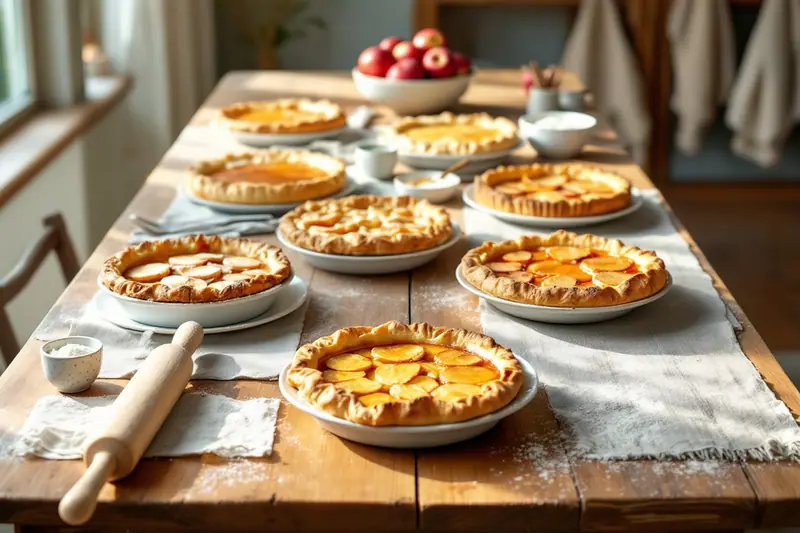
Apples are coming in, the first cool mornings have arrived, and somewhere a sign-up sheet for the harvest supper has your name next to "pies, 10." Ten pies is not ten times the work of one pie. It is closer to four times, if you plan it like a small bakery would: make all the dough in one session, fill and freeze in a second, bake in a third. What follows is how I organize it, with the numbers I actually use.
How many pies you need
Start with slices, not pies. A standard 9-inch pie cuts into 8 slices at a supper where it is the only dessert, and into 10 thinner slices when there are three or four kinds on the table and people want a sliver of each. Most guests at a harvest supper or a big Thanksgiving take 1.5 slices of pie on average, because half of them try two kinds.
| Guests | Slices needed (1.5 each) | Pies at 8 slices | Pies at 10 slices |
|---|---|---|---|
| 20 | 30 | 4 | 3 |
| 40 | 60 | 8 | 6 |
| 75 | 113 | 14 | 12 |
| 120 | 180 | 23 | 18 |
I round up by one pie for every 30 guests. Someone always drops a pie in a parking lot, and leftover pie has never once gone to waste. For the broader question of how much food a crowd eats across all the courses, the guide to how much food per guest has the full tables.
For the mix, I aim for roughly half fruit pies (apple above all), a third custard pies (pumpkin, sweet potato, buttermilk) and the rest nut pies. Pecan is rich enough that 10 slices per pie is the right cut every time.
Crust in bulk
One batch of dough in a stand mixer or a big bowl makes enough for five double-crust pies or ten single crusts. Making it in one session is the single biggest time saver, because the flour is already out, the counters are already floury, and you are only cleaning up once.
Weigh everything
At this scale, cups drift. A cup of flour scooped from the bag can weigh anywhere from 125 g to 150 g depending on how packed it is, and across 12 cups that difference adds up to most of an extra cup. Weigh the flour and the butter. The recipe card below gives both.
Keep the butter cold
Cut the butter into half-inch cubes, spread them on a sheet pan and freeze them for 15 minutes before mixing. The water should be ice water, measured from a pitcher with ice in it, not straight from the tap. In a warm kitchen I chill the flour too. The goal is butter in pea-sized and flattened almond-sized pieces when you stop mixing, because those pieces turn into steam pockets and layers in the oven.
Divide by weight
When the dough comes together, weigh the whole mass and divide it. For a 9-inch pie I use 340 g discs for a bottom crust and 300 g for a top crust; for single-crust pies, 340 g each. Flatten each portion into a disc about an inch thick, wrap it well, and write the weight and the date on the wrap with a marker. Discs keep 3 days in the refrigerator or 3 months in the freezer.
Freezing unbaked crusts and pies
This is where quantity baking gets manageable. I do almost nothing on the day except bake.
Unbaked bottom crusts
Bottom crusts freeze beautifully right in the pie plates. Roll, fit, crimp, freeze uncovered on a sheet pan until hard (about an hour), then stack them with a square of parchment between each and wrap the stack. They go straight from the freezer into the oven for blind baking with no thawing.
Unbaked fruit pies
Whole unbaked fruit pies freeze well too, and baking them from frozen gives a crisper bottom than baking them fresh. Assemble the pie completely, but do not cut the steam vents and do not brush on egg wash. Freeze it uncovered until solid, then wrap it in two layers of plastic and one of foil. They keep for 3 months. On baking day, unwrap, cut the vents, brush with egg wash and sugar, and bake at 425°F (220°C) for 20 minutes, then at 375°F (190°C) for 50 to 70 minutes more. The pie is done when the juices bubble thickly through the vents, not just at the edges. That thick bubbling means the starch has cooked and the filling will set.
For a frozen fruit pie, use a little more thickener than you would for a fresh one, about an extra tablespoon of cornstarch or tapioca per pie, since the fruit releases more liquid as it thaws in the oven.
Custard pies
Custard pies do not freeze well unbaked. The filling separates and weeps. Make the filling up to 2 days ahead and keep it covered in the refrigerator, then pour it into a frozen, blind-baked shell on baking day.
Oven rotation
A home oven holds two pies per rack comfortably and four pies total on two racks, if the pies are on rimmed sheet pans to catch drips. Six is possible in a wide oven, but air stops moving and the bottoms suffer. Plan on four at a time.
Two things matter. First, swap the pans top to bottom and front to back halfway through baking, because every oven has a hot corner. Second, keep the oven temperature honest. A cold pie lowers the oven temperature sharply when it goes in, and a load of four frozen pies can pull a 425°F (220°C) oven down to 350°F (175°C) for the first 10 minutes. An oven thermometer is cheap and tells you the truth.
Here is a real schedule for 12 pies in one oven: 6 apple (frozen, unbaked), 4 pumpkin and 2 pecan.
| Time | Oven | What happens |
|---|---|---|
| 7:00 | Heat to 425°F (220°C) | Take filling out of the refrigerator |
| 7:30 | 4 apple pies in | Set timer for 20 minutes |
| 7:50 | Lower to 375°F (190°C) | Rotate pans |
| 8:50 | Apple batch out | Check for thick bubbling; cool on racks |
| 9:00 | 2 apple, 2 pecan in at 375°F (190°C) | Pecan needs no high-heat start |
| 10:00 | Pecan out (center jiggles slightly) | Apples stay 15 to 20 minutes more |
| 10:20 | Apples out; blind-bake 4 shells at 400°F (200°C) | 20 minutes with weights, 8 without |
| 10:50 | Fill pumpkin, bake at 350°F (175°C) | 50 to 60 minutes |
| 11:50 | Pumpkin out | Edges set, center wobbles like gelatin |
That is under five hours of oven time for twelve pies. If you have access to a second oven (a neighbor's, the church kitchen's), you can halve it.
Which pies hold
Not all pies travel or wait equally.
- Apple, pear, mixed fruit: the best keepers. Fine at room temperature for 2 days loosely covered. A good double-crust apple, like the Vermont apple pie with its mix of firm apples, slices better the day after baking than the day of.
- Pecan and other nut pies: sturdy, and they keep 2 days at room temperature, though many cooks refrigerate them because of the eggs. A maple-sweetened pecan pie is a fine choice for a New England table.
- Pumpkin, sweet potato, custard and cream pies: refrigerate within 2 hours of cooling and keep them cold until serving. These are the ones to bake last, ideally the day before the event.
- Berry pies: delicious, but the bottoms soften by the second day. Bake them the day before at most.
- Meringue pies: they weep. Leave them off a big supper list unless you can top them that morning.
Cool every pie completely on a rack before covering it. A warm pie under plastic steams its own crust soft. Fruit pies need 3 to 4 hours to cool and set; custard pies need at least 2 hours before they go into the refrigerator.
Transport
Pie boxes from a restaurant supply store are worth the few dollars. Lacking those, a 9-inch pie fits nicely in a clean shirt box or a sheet cake box, and two pies fit side by side in a 12-by-18-inch sheet pan with a damp towel underneath to keep them from sliding.
In the car, pies ride flat on the floor of the back seat or in the trunk on a folded towel, never on a seat (seats slope backward). Custard pies should travel cold, in a cooler if the drive is over 30 minutes. Bring a pie server, a sharp knife, a roll of paper towels and a few spare pie plates in case one crust cracks on arrival.
Label each pie on the box lid: kind, and whether it contains nuts. People with allergies will thank you, and the person setting up the dessert table can arrange them without lifting every lid.
About the box below: it links to a shop or service we think fits this page. If you buy or join through it, this journal may be paid a commission, and the price stays the same for you. Our recipes and menus are never written to order.
The big-batch crust
This is my all-butter crust scaled for five double-crust pies or ten single crusts. It is rich, flaky and forgiving, and it browns to a deep gold without shortening.
From the recipe box
All-butter pie crust, big batch
Dough for 5 double-crust or 10 single-crust 9-inch pies
- Prep
- 45 min
- Cook
- 0 min
- Rest
- 2 hr
- Total
- 2 hr 45 min
Dough
- 13 1/2 cups1690 g all-purpose flour
- 2 tbsp25 g sugar
- 1 tbsp15 ml fine salt
- 10 sticks1130 g cold unsalted butter, cut into 1/2-inch cubes and frozen 15 minutes
- 3 cups720 ml ice water, plus more as needed
- 3 tbsp45 ml cider vinegar
Method
- Whisk the flour, sugar and salt in your largest bowl, or work in two batches in a stand mixer fitted with the paddle.
- Add the frozen butter and cut it in with a pastry blender or on low speed for 1 to 2 minutes, until the largest pieces are the size of almonds and the rest look like peas.
- Stir the vinegar into the ice water. Drizzle in 2 1/2 cups of the water while tossing with a fork or mixing on low for 30 seconds.
- Squeeze a handful of dough. If it holds together without crumbling, stop; if it falls apart, add more water a tablespoon at a time.
- Turn the shaggy dough onto the counter and press it together with your palms in a few quick strokes, without kneading.
- Weigh the dough and divide it into 340 g portions for bottom crusts and 300 g portions for top crusts.
- Flatten each portion into a disc about 1 inch thick, wrap tightly and label it with the weight and date.
- Refrigerate at least 2 hours before rolling, or up to 3 days; freeze up to 3 months and thaw overnight in the refrigerator.
- Roll each disc to a 12-inch round for the bottom and 11 inches for the top, keeping the dough cold enough that the butter stays in visible streaks.
Notes from the kitchen
- If the kitchen is warm, chill the flour and the bowl for 30 minutes before you start.
- Blind-bake single crusts at 400°F (200°C) for 20 minutes with pie weights, then 8 to 10 minutes uncovered until the bottom looks dry and lightly golden.
- Scraps can be pressed together once, rolled and cut into leaves for decorating tops.
Splitting the work
If you are the pie captain for a church supper or a reunion, you do not have to bake every pie yourself. Hand out discs of your dough, already weighed, to the bakers who sign up. Everyone gets the same crust, the table looks consistent, and nobody has to make dough in a small kitchen. Ask each baker for a specific kind so you do not end up with nine apple pies and no pumpkin. Give them the day and time to drop off and ask them to label the box.
A weekend plan
For a Saturday supper with 12 pies, this is the order I follow:
- Two weekends before: make the big batch of dough. Freeze all but what you need for the next step.
- The following weekend: roll and fit the bottom crusts; assemble and freeze the apple pies; freeze the shells for custard pies.
- Thursday: make the pumpkin filling and refrigerate. Buy cream for whipping.
- Friday: bake everything on the schedule above. Cool fruit pies on the counter; refrigerate custard pies once cool.
- Saturday: whip cream (1 cup of heavy cream for every 2 pies), box the pies and pack the car flat.
When the dessert table is set, put a knife and server at each pie and cut the first two slices of every one yourself. People hesitate to cut into an untouched pie, and a pie already started gets eaten, down to the last crumb on the plate.
Topics: Cakes & Baking | The Seasonal Table

Abigail bakes the cakes, pies and bread for her family's celebrations in western Massachusetts. She writes about layer cakes, crusts, quick breads and baking ahead.