Carving a Turkey for a Crowd: Resting, Slicing and the Platter
Every family has the person who carves, and in most of them that person learned by standing next to someone else who was doing it badly. The turkey comes out, everyone crowds the kitchen, somebody hands over a dull knife, and twenty minutes later there is a pile of shredded breast meat and a carcass that looks like it lost an argument.
It doesn't have to go that way. Carving is a short sequence of cuts that follow the bird's joints, and once you know where the joints are, a 16-pound turkey comes apart in about fifteen minutes. The real work happens before the knife comes out: resting the bird long enough, having the tools ready and knowing where the slices are going to sit while you finish. Here is how I do it with a houseful of people waiting.
Resting: longer than you think
A turkey straight out of the oven is full of hot juices under pressure. Cut into it right away and they run out onto the board. Let it rest and the muscle fibers relax, the juices settle, and the internal temperature keeps climbing a few degrees on its own.
Pull the turkey when the thickest part of the thigh reads 165°F (74°C) on an instant-read thermometer, or a few degrees under if you are confident about carryover heat; the breast is fine at 160°F (71°C) to 165°F (74°C). Move it to a cutting board or a sheet pan, tent it loosely with foil (tight foil steams the skin soft), and leave it alone.
| Turkey size | Minimum rest | Comfortable rest |
|---|---|---|
| 10 to 12 lb | 20 minutes | 40 minutes |
| 13 to 16 lb | 30 minutes | 50 minutes |
| 17 to 20 lb | 40 minutes | 60 minutes |
| 21 lb and up | 45 minutes | 75 minutes |
A big bird stays hot for over an hour. That is not wasted time. It is when you make the gravy, reheat the stuffing and get the sides into the oven. Nobody has ever complained that the turkey was too warm after a long rest.
Tools: fewer than you'd expect
You do not need a carving set from a wedding registry. You need:
- A long, sharp knife. A 10-inch slicing knife is ideal, a sharp chef's knife is fine. Sharpen it the day before. A dull knife tears the meat and slips on the skin, and that is how people cut themselves on holidays.
- A sturdy fork or tongs to hold the bird steady. I use tongs on the legs and my hand, in a clean towel, on the breast.
- A big cutting board with a groove for juices, set on a damp towel so it doesn't skate across the counter.
- A second board or sheet pan for the pieces as they come off.
- A sharp boning knife or kitchen shears for the joints and the backbone, optional but useful.
- A warmed platter. Run it under hot water and dry it, or put it in a 200°F (95°C) oven for ten minutes.
- A small pan of hot broth, which I will come back to.
An electric knife works, and plenty of good carvers swear by them. It does best on the breast and struggles at the joints.
Step by step
The method that works best for a crowd is to take the turkey apart first and slice second. Carving thin slices off the breast while it is still on the bird looks good in old paintings and gives you uneven, ragged pieces. Taking the whole breast off in one lobe and slicing it across the grain gives you neat slices, each with a strip of skin.
- Set the bird breast up, legs pointing toward you. Cut the string if it was trussed.
- Remove the legs. Pull one leg gently away from the body and slice through the skin between the thigh and the breast. Keep pulling the leg outward and down until the thigh joint pops out of its socket. Cut through the joint and along the backbone to free the whole leg, taking the oyster (the small round piece of dark meat on the back) with it. Repeat on the other side.
- Separate the drumstick from the thigh. Lay the leg skin side down and find the line of fat between the two. Cut straight through it; if you hit bone, move the knife a quarter inch and try again.
- Take off the wings. Pull each wing out and cut through the joint where it meets the body.
- Remove each breast whole. Find the breastbone running down the center. Cut down along one side of it, keeping the knife tight against the bone, and use long, gentle strokes along the rib cage to ease the whole breast half off in one piece. Repeat on the other side.
- Slice the breast across the grain. Lay the breast skin side up and cut crosswise into slices about 1/2 inch thick. Thicker slices stay moist longer on a buffet than thin ones.
- Slice the thigh meat. Cut the meat off the thigh bone in two or three pieces, then slice it. Leave the drumsticks whole for the people who want them.
For a 16-pound turkey that gives you roughly 10 to 11 pounds of meat, which serves 14 to 16 people at a dinner with plenty of sides. The quantities guide in Thanksgiving for twenty explains why two smaller birds can be easier than one giant one, and two smaller birds carve faster too.
Keeping slices warm and moist
Turkey breast cools quickly once it is sliced, and it dries out even faster. A few habits make the difference.
Slice only what you need. For a sit-down dinner, slice one breast half, put it on the platter and leave the second half whole under foil. Slice it when the platter comes back for seconds.
Keep a small saucepan of hot turkey or chicken broth on the stove. Ladle two or three tablespoons over the sliced meat on the platter just before it goes to the table. It adds moisture and heat without making anything soggy. This is the single best thing you can do for a buffet.
If the turkey has to wait on a buffet, set the platter over a chafing dish or put the meat in a covered pan with a little broth in a 200°F (95°C) oven. Hot food should stay at 140°F (60°C) or above while it is out. After two hours at room temperature it should go in the refrigerator, and the rules in keeping party food safe apply to the turkey as much as the dips.
Don't carve too early. It is tempting to carve while people are still finding their seats, but carved meat stays warm for about 15 minutes on a warm platter. Whole meat under foil stays warm for an hour.
Arranging the platter
A platter should be easy to serve from, not just pretty. People take what they can reach without thinking, so put the slices where hands go first.
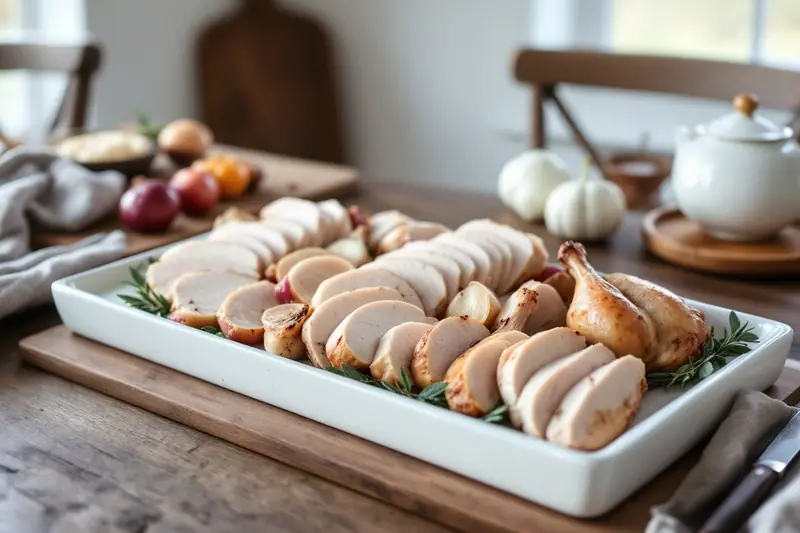
- White meat in the center, in overlapping rows like shingles, skin side up.
- Dark meat slices along one side so the dark meat people can find them without digging.
- Drumsticks and wings at the ends, where they look generous and don't slide onto the slices.
- Garnish lightly. A few sprigs of sage or thyme and some roasted onion halves are plenty. Lettuce leaves get soggy and nobody eats them.
For a buffet line of 25 or more, use two platters: one at each end of the table, or one on each side if the line runs both ways, as described in setting up a buffet table. Put a serving fork and tongs on each platter. A spoon of gravy over the slices is fine, but keep a full gravy boat next to it.
When something goes wrong
The breast is dry
Slice it thicker, pour hot broth over it, and set the gravy right next to it. No one will notice.
The thighs are pink at the joint
Pink color near the bone does not always mean undercooked, especially in younger birds. Check with the thermometer. If the thigh meat is under 165°F (74°C), take the legs off, put them on a sheet pan and give them 15 to 20 minutes at 375°F (190°C) while you carve the breast.
The skin isn't crisp
Once it is carved, crisp skin is mostly gone anyway. Put the slices under the broiler for one minute before the broth goes on, and watch them closely.
You can't find the joint
Wiggle the leg or wing and watch where the skin moves. The joint is where the movement starts.
The carcass
Do not throw it away. A turkey carcass makes the best stock of the whole year, and it is the easiest thing to make on the Friday after.
Strip the leftover meat off the bones the same evening and refrigerate it in shallow containers within two hours of dinner. Break the carcass into pieces so it fits in your biggest pot, add the neck and wing tips if you saved them, one or two onions halved with the skins on, two carrots, two celery ribs, a few peppercorns and a bay leaf. Cover with cold water by an inch, about 5 quarts for a 16-pound bird.
Bring it to a bare simmer, skim off the foam in the first 20 minutes, and let it barely bubble for 3 to 4 hours. Do not let it boil hard, or it turns cloudy and greasy. Strain it, cool it quickly by setting the pot in a sink of ice water, and refrigerate overnight. The fat rises and hardens, and you can lift it off in one piece.
A 16-pound carcass gives you about 3 to 4 quarts of stock. It keeps 4 days in the refrigerator or 3 months in the freezer. That stock is the start of a turkey and wild rice soup or a pot of noodle soup for a cold Saturday, and if the crowd is staying the weekend, the method for soup for a crowd scales it up for twenty bowls.
If you are tired on Thursday night, put the carcass in a large bag, press the air out and refrigerate it. It will keep two days before you need to make stock. You will be glad you did when the soup comes together on Sunday with almost no effort.
Topics: Main Dishes | Kitchen Craft

Wes grew up on the New Hampshire side of the river and does most of his cooking over a grill or in a big roasting pan. He writes about main dishes, fish and feeding a crowd outdoors.