Grilling for Fifty: Menu, Grill Math, Crew and a Timeline
Grilling for fifty people is not the same job as grilling for eight, made bigger. With eight, you stand at the grill with a drink, flip a few things, and everyone eats when it is ready. With fifty, you are running a small kitchen outdoors, on equipment that was designed for a family of four, in weather you do not control, and the main problem is not cooking. It is space and timing. Get those right and it is one of the best parties there is. Get them wrong and you will be handing out burgers at nine o'clock to people who ate chips for dinner.
June is when these parties start: graduations, the first reunion of the summer, a fiftieth birthday in somebody's back field. Here is how I plan one.
Pick food that grills fast and forgives
The menu decides everything. What you want is food that cooks in 15 minutes or less, can be done in batches, and tastes fine at serving temperature rather than straight off the fire.
Good choices for a crowd
Boneless chicken thighs, sausages, burgers, flank or skirt steak cooked whole and sliced, thick vegetable planks (zucchini, peppers, onions, eggplant), corn, halloumi.
Poor choices for a crowd
Bone-in chicken pieces from raw (too slow and too easy to undercook), individual steaks cooked to order, whole fish, kebabs (a nice idea until somebody has to thread four hundred of them).
Boneless thighs are my first choice. They stay juicy if they go a minute too long, they take a marinade well, and they cook in about 10 minutes. Chicken breasts dry out on the second batch and nobody wants to eat them cold.
A menu that works for fifty:
- Marinated grilled chicken thighs (recipe below)
- Grilled sausages, precooked
- Grilled vegetable platter
- Two cold salads made the day before: a potato salad and a corn and tomato salad
- Rolls, butter, and a big green salad
- Watermelon and two sheet cakes
Everything on the grill is a main or a side that stands up to sitting. Everything else is made ahead or bought. For a version for a bigger crowd, with the quantities written out, see the summer barbecue buffet for 85.
How much to buy
With two grilled mains and solid sides, plan on about 6 ounces of raw boneless chicken and one sausage per person. Teenagers and people who have been playing horseshoes all afternoon will push this up. The how much food per guest guide has the numbers for the salads and dessert.
| Item | For 50 | Notes |
|---|---|---|
| Boneless chicken thighs | 18 lb | About 72 thighs |
| Sausages | 55 to 60 links | Precooked or poached ahead |
| Vegetables for grilling | 12 lb | Zucchini, peppers, red onions |
| Potato salad | 12 lb | About 4 oz per person |
| Corn and tomato salad | 8 lb | |
| Rolls | 6 dozen | |
| Charcoal | 40 to 50 lb | Or two full propane tanks plus a spare |
Grill surface math
This is the part people skip, and it is why the food comes off late.
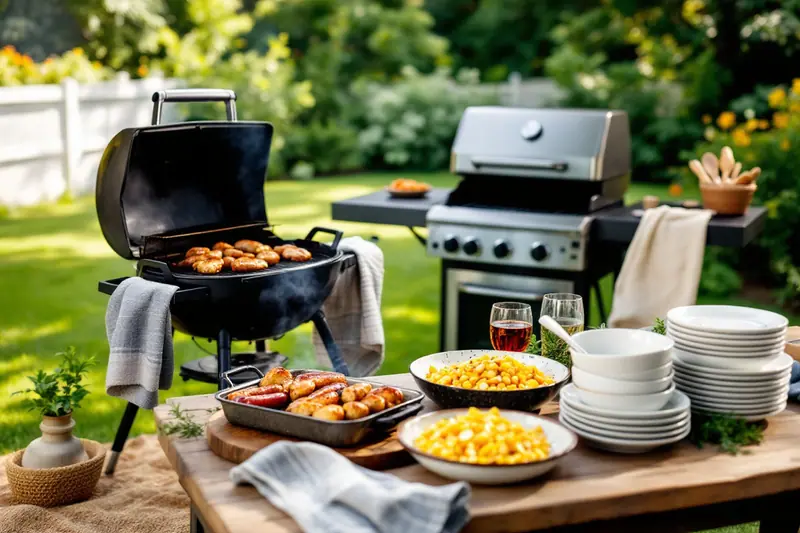
A standard 22-inch charcoal kettle has about 360 square inches of cooking surface. A typical three-burner gas grill has 400 to 450 square inches on the main grate. A boneless thigh, flattened, takes up about 4 by 5 inches, and needs a little room around it, so call it 25 square inches. That puts about 14 thighs on a kettle and about 16 on a three-burner gas grill at once.
Now the worked example. Seventy-two thighs, 14 at a time on one kettle, is six loads. At 12 minutes a load, including the time to take one batch off and lay down the next, that is 72 minutes of grilling for the chicken alone. Add the sausages (two loads), the vegetables (three loads), and you are looking at more than two and a half hours at one grill. That is too long.
With three grills going at once, the same food takes under an hour. So my rule is one grill for every 15 to 20 guests. For fifty people, that means three grills.
Borrowing grills
Nobody owns three grills. Everybody knows someone who owns one. Borrow them a week ahead, not the morning of, and check them when they arrive: grates clean, propane tanks full, the igniter working, all the legs still attached. Put a piece of tape on each with the owner's name so they go home to the right garage.
Set them up in a line with a table between every pair for landing pans and tools, on level ground, at least ten feet from the house, the deck rail and anything else that burns. A flat lawn is better than a deck. Put a bucket of water or a fire extinguisher at the end of the line.
Mixed grills are fine. Charcoal kettles give more flavor; gas grills are easier to control and faster to restart between batches. I put the chicken on charcoal and the vegetables on gas.
Cook ahead, finish on the grill
The fastest way to grill for a crowd is to do as little actual cooking on the grill as possible.
- Sausages: poach raw sausages in simmering water or beer for 10 to 12 minutes the morning of the party, cool, and refrigerate. On the grill they only need color, about 5 minutes. Precooked sausages skip the poaching.
- Bone-in chicken or ribs: if you insist on them, bake them in a 325°F (165°C) oven the day before until done, refrigerate, and finish over medium heat with sauce until hot through, 165°F (74°C) in the center.
- Vegetables: cut and oil them the day before. Grill them early in the afternoon and serve at room temperature with a vinaigrette. They are better that way.
- Chicken thighs: marinate the night before, and grill them in batches through the hour before dinner.
Holding cooked meat safely
Food off the grill needs to stay above 140°F (60°C) until it is eaten, or be cooled and served cold. For the chicken, I lay each batch in a disposable aluminum hotel pan, cover it with foil, and keep the pans in one of two places:
- An oven set to 200°F (93°C) in the kitchen, if it is close to the grills.
- An insulated cooler with no ice in it, lined with a couple of old towels. A cooler packed with covered hot pans holds the heat surprisingly well for about an hour.
Check the meat with a thermometer before it goes out. Once it is on the buffet, it gets the standard two hours, or one hour if the day is above 90°F (32°C). The party food safety guide has the full rules, including how to keep the potato salad cold on a hot afternoon.
Raw chicken needs its own space. Keep it in the cooler on ice until it goes on the grill, use one set of tongs for raw and another for cooked, and never put cooked chicken back in the pan the raw chicken came in.
Crew roles
Three grills means at least three people at the grills. I have tried running two grills myself. It does not end well for the chicken.
- Grill lead: decides what goes on when, keeps the timeline, checks temperatures. This is you.
- Two grill hands: one at each of the other grills. They need to know what done looks like and how to read a thermometer, and they should not be drinking much before dinner.
- Runner: carries raw food from the cooler to the grills and cooked pans to the holding cooler or oven. Keeps the tongs separate.
- Buffet lead: sets out the cold food, swaps in fresh pans of hot food, keeps the line moving. The guide to setting up a buffet table is worth reading together before the day.
Brief everyone the afternoon before, five minutes, with the timeline printed out.
The timeline
For a party where people arrive at 4:00 and eat at 5:30:
| Time | Job |
|---|---|
| Day before | Marinate chicken; make salads; cut and oil vegetables; borrow and set up grills |
| 9:00 a.m. | Poach sausages, cool, refrigerate; ice down drinks |
| 1:00 p.m. | Light the gas grill; grill vegetables; arrange on platters |
| 2:30 p.m. | Set up the buffet tables and the serving line |
| 3:30 p.m. | Light the charcoal (about 30 minutes to be ready) |
| 4:00 p.m. | Guests arrive; set out chips, vegetables and dip |
| 4:15 p.m. | First chicken batches on all grills |
| 4:45 p.m. | Turn the oven to 200°F (93°C) for holding; keep the chicken coming |
| 5:15 p.m. | Sausages on; salads and rolls out |
| 5:30 p.m. | Dinner; keep two grills going for the last batches |
| 6:30 p.m. | Shut down the grills; pack leftovers in shallow containers on ice |
The recipe
From the recipe box
Lemon-garlic grilled chicken thighs for fifty
About 72 thighs, serves 50
- Prep
- 45 min
- Cook
- 1 hr
- Rest
- 8 hr
- Total
- 9 hr 45 min
Chicken
- 18 lb8.1 kg boneless, skinless chicken thighs
Marinade
- 1 1/2 cups360 ml olive oil
- 1 cup240 ml fresh lemon juice (about 6 lemons), plus the grated zest of 3
- 1/2 cup120 ml Dijon mustard
- 1/3 cup80 ml honey
- 2424 garlic cloves, grated or minced
- 1/4 cup60 ml kosher salt
- 3 tbsp45 ml dried oregano
- 2 tbsp30 ml smoked paprika
- 1 tbsp15 ml freshly ground black pepper
- 1 tsp5 ml red pepper flakes
Method
- Whisk all the marinade ingredients together in a large bowl until the honey dissolves.
- Divide the chicken among six gallon zip-top bags, about 3 lb per bag, and pour an equal share of marinade into each.
- Press out the air, seal, and massage the bags to coat. Refrigerate flat on sheet pans for at least 4 hours and up to 24, turning once.
- Set up the grills for medium-high direct heat, about 400°F (205°C) at the grate. Oil the grates well.
- Lift the thighs from the marinade, letting the excess drip off, and lay them flat with space between, smooth side down. Discard the used marinade.
- Grill without moving for 5 to 6 minutes, until the underside releases easily and has dark grill marks.
- Turn and grill 4 to 5 minutes more, until the thickest thigh reads 175°F (79°C). Do not go below 165°F (74°C).
- Move each batch to a foil-covered hotel pan and hold at 140°F (60°C) or above in a 200°F (93°C) oven or a towel-lined cooler.
- Scrape and oil the grates between every second batch to keep the next ones from sticking.
Notes from the kitchen
- The lemon juice softens the surface if the chicken marinates longer than 24 hours, so keep to the window.
- Slice a few thighs on the diagonal and lay them on top of the pan so the buffet looks generous and guests take smaller pieces.
Questions from hosts
Can I grill everything ahead and reheat it?
You can, but it tastes reheated. Grill the vegetables ahead and serve them at room temperature, and grill the chicken in the hour before dinner. That is the compromise that works.
What if it rains?
Grills work in the rain if they are under a canopy that is tall and open on the sides. Never grill in a garage or under a low porch roof. If the forecast is bad, have the oven ready as a backup for the chicken: 425°F (220°C) on sheet pans for about 20 minutes.
How do I keep the grills from running out of fuel halfway?
Have a full spare propane tank for every gas grill and a second bag of charcoal for each kettle. Add fresh charcoal to a kettle after the third batch, before it fades.
At the end of the night, close the vents on the kettles and leave them where they are. You can clean them in the morning, and they will still be hot enough to burn somebody who tries to move one in the dark.
Topics: Main Dishes | Menus & Planning

Wes grew up on the New Hampshire side of the river and does most of his cooking over a grill or in a big roasting pan. He writes about main dishes, fish and feeding a crowd outdoors.