Keeping Party Food Safe: Buffet Temperatures and Timing
My family entertained so often that I was plating deviled eggs before I could reach the counter without a step stool, and the one thing my mother never compromised on was the clock. Food went out, a time went on a scrap of paper by the stove, and at the end of that time the platter came back in, no matter how pretty it still looked. At the time I thought she was fussy. Now I do the same thing at every party, because it is the one habit that keeps a good afternoon from turning into a bad night for someone.
August is the month this matters most. The porch is hot, the grill is going, the potato salad is sitting in the sun while everyone talks. None of what follows is complicated. It comes down to a few temperatures, a clock and a thermometer, all of it in line with the general advice the USDA gives home cooks.
The numbers to remember
Bacteria that cause foodborne illness grow fastest between 40°F (4°C) and 140°F (60°C). Food safety guidance calls this the danger zone, and the whole point of party food safety is to keep perishable food out of it, or in it for only a short time.
- Cold food: hold at 40°F (4°C) or below.
- Hot food: hold at 140°F (60°C) or above.
- Reheating leftovers: bring to 165°F (74°C), checked with a thermometer.
- The 2-hour rule: perishable food should not sit at room temperature for more than 2 hours in total.
- The 1-hour rule: when the air is above 90°F (32°C), as it often is outdoors in summer, cut that to 1 hour.
Write these on an index card and tape it inside the cabinet nearest the stove. I am not joking. When the kitchen is full and someone asks whether the chicken can go back out, the card answers the question so you do not have to.
The 2-hour rule, in practice
The two hours start when the food leaves the refrigerator or the oven, not when the first guest arrives. That includes the twenty minutes the platter spent on the counter while you looked for the serving spoons.
My routine:
- Note the time. Every dish that goes out gets a time on a piece of masking tape stuck to the underside of the platter, or on a list by the kitchen door.
- Put out smaller amounts. Instead of one huge bowl of chicken salad, put out a medium bowl and keep the rest cold in the refrigerator. Swap in a fresh bowl rather than topping off the old one.
- Swap, do not combine. Never pour fresh food on top of food that has been sitting out. The old food has its own clock and it does not reset.
- Pull it on time. At two hours (one hour on a hot porch), food that has been at room temperature goes in the trash. Not in the refrigerator for tomorrow.
Foods held hot in a chafing dish at 140°F (60°C) or above, or cold on ice at 40°F (4°C) or below, are not on the 2-hour clock while they stay at that temperature. That is why the equipment below matters so much for a long party.
Holding hot food: chafing dishes, slow cookers and warm ovens
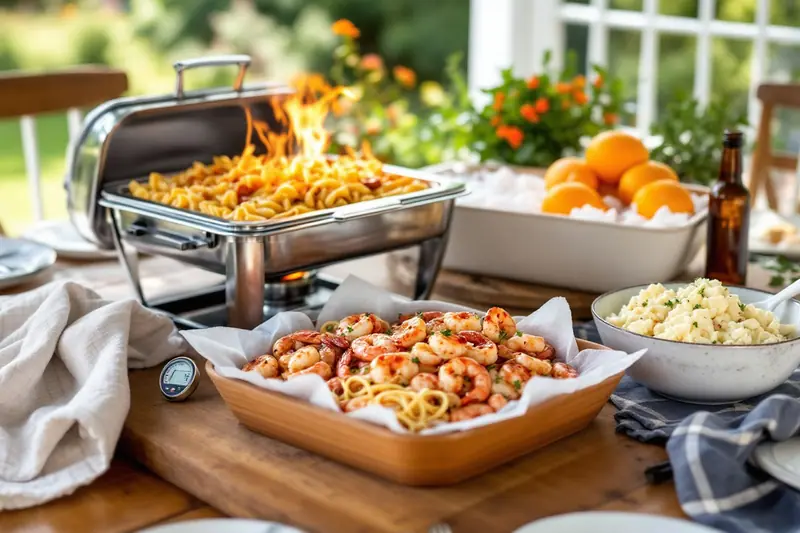
A chafing dish is a pan of food set inside a larger pan of hot water, warmed from below by a small fuel canister or an electric element. It keeps hot food hot. It does not heat cold food quickly or safely, so everything must go into a chafing dish already hot, at 165°F (74°C) or above.
How I set one up:
- Fill the water pan with about an inch of very hot water from the kettle, not cold tap water.
- Light the fuel 15 minutes before the food goes in, so the water is steaming.
- Bring the food out of the oven at a full, steaming heat and put it straight in.
- Keep the lid on between guests whenever possible.
- Check the food temperature with a thermometer every 30 minutes, in the center and at the edges. It should read 140°F (60°C) or higher.
- Have spare fuel on hand. Most canisters run 2 to 6 hours depending on type; read the label and note the time you lit it.
Slow cookers set on warm and electric roasters are excellent for soups, meatballs, pulled pork and beans. A warm oven at 200°F (93°C) holds trays of food between batches, though dry foods will dry out further the longer they sit.
Holding cold food: ice beds and nested bowls
For cold food, ice is your best friend, and you need more of it than you think. Plan on about 1 pound of ice per guest for drinks alone on a hot day, and then add ice for the food.
Nested bowls. Set the serving bowl inside a larger bowl filled with ice and a little cold water. The water makes the ice cling to the sides of the inner bowl and chill it evenly. This works beautifully for potato salad, pasta salad, coleslaw and dips.
Ice beds. For shrimp, oysters, cut fruit and anything on a platter, use a deep tray or a rimmed sheet pan filled with crushed ice, and set the platter on top or nestle small bowls into it. Drain off meltwater every hour, and add more ice as it melts.
Chill the serving dishes too. A cold platter keeps food cold longer than one taken from a warm cupboard. Stack them in the refrigerator the morning of the party.
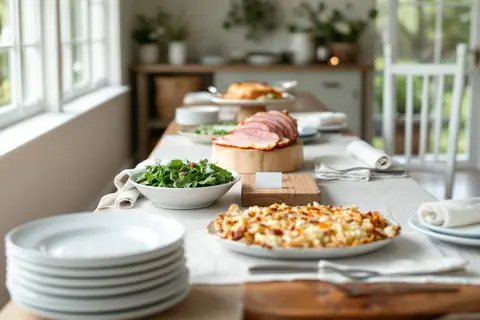
The most delicate items, such as seafood salads, cream fillings, cut melon and anything made with mayonnaise and eggs, should always be on ice or in a cooler, never just on the table. If you are setting up a long buffet, the guide on setting up a buffet table has a layout that keeps the hot dishes and the iced dishes where they can be watched and swapped.
Cooling large batches safely
Big pots of chili, soup, braised meat and rice are where home cooks run into the most trouble, because a big batch cools slowly in the center. The general guidance: cool cooked food from 140°F (60°C) to 70°F (21°C) within 2 hours, and then from 70°F (21°C) to 40°F (4°C) within the next 4 hours.
That is hard to do with a full stockpot in the refrigerator. A few ways to speed it:
- Divide it. Pour soups and stews into shallow containers no more than 2 inches deep. Cut large roasts into smaller pieces.
- Use an ice bath. Set the pot in a sink full of ice water and stir every few minutes. A clean plastic bottle of frozen water dropped into the pot (an ice wand, if you have one) speeds it more.
- Leave the lids off until the food is cold, then cover.
- Space things out in the refrigerator so cold air can move around each container. Do not stack hot containers on top of each other.
- Check your refrigerator. It should be at 40°F (4°C) or below. A cheap appliance thermometer on the middle shelf tells you.
Never leave a big pot on the stove to cool overnight. It spends the whole night in the danger zone.
Reheating to 165°F (74°C)
Leftovers and make-ahead dishes should be reheated until they reach 165°F (74°C) in the center. Soups, sauces and gravies should come to a rolling boil. In a microwave, cover the dish, stir halfway through and let it stand a minute before checking.
Reheating in a slow cooker is slow, so it is not a good idea to start with cold food. Reheat on the stove or in the oven first, then move the hot food to the slow cooker to hold.
Transporting food to a party
Bringing food to someone else's house, a church hall or a picnic adds time outside the refrigerator. The rules are the same; you just have to plan for the car.
- Cold food: pack in coolers with ice packs or ice, filled as full as possible (a full cooler stays cold longer). Put the cooler in the air-conditioned car, not the trunk.
- Hot food: wrap the hot dish in foil, then in several layers of towels or newspaper, and pack it in an insulated carrier or an empty cooler (one used only for hot food). It should arrive steaming. If the trip is over an hour, plan to reheat on arrival instead.
- Raw meat for grilling goes in its own cooler or on the bottom of the cold cooler, in leakproof containers, so juices cannot drip on anything else.
- Cut and assemble at the destination where you can. Salads hold better when dressed on site.
The thermometer habit
You cannot tell whether food is at a safe temperature by touch or by looking. A simple instant-read thermometer is the most useful party tool in my kitchen, more than any serving platter.
Use it to:
- Check that meat and poultry are cooked: poultry to 165°F (74°C), ground meats to 160°F (71°C), and whole cuts of beef, pork and lamb to 145°F (63°C) with a 3-minute rest.
- Check chafing dishes and slow cookers every half hour.
- Check reheated food before it goes out.
- Check the refrigerator and coolers.
Calibrate it now and then by sticking the probe in a glass of ice water. It should read 32°F (0°C). Wash the probe in hot soapy water between foods, and especially after raw meat.
Questions from hosts
Can I leave the cheese platter out all night?
Hard aged cheeses hold up well, but a platter with soft cheeses, cured meats and fruit should follow the 2-hour rule. Put out a small board and replenish from the refrigerator. The same goes for the passed trays described in passed hors d'oeuvres for a crowd.
What about desserts?
Cakes and cookies without cream fillings can sit out. Anything with custard, whipped cream, cream cheese frosting or a cream pie filling follows the 2-hour rule.
The party went long. Is the food still good?
If it has been at room temperature past two hours, or one hour on a hot day, throw it out. When in doubt, it goes. Food is cheaper than the alternative.
For more on equipment and technique, the Kitchen Craft pages cover the tools. At my house, the masking tape and marker live in the drawer next to the thermometer, so whoever carries a platter out also writes the time on it.
Topics: Kitchen Craft

Tomoko grew up in a family that entertained constantly, in Connecticut and later in Boston. She writes about hors d'oeuvres, party platters and the kitchen habits that keep food safe for a crowd.