Setting Up a Buffet Table That Keeps the Line Moving
A buffet is supposed to be the easy way to feed a crowd, and it is, until forty people are standing in a line that has not moved in ten minutes because someone is trying to balance a fork, a napkin, a wine glass and a plate while spooning gravy. Almost every slow buffet I have watched had the same problem: not too little food, but food set out in the wrong order on a table that was too short. The good news is that the fix costs nothing. It is a matter of placement.
I set up buffets for reunions, church suppers and backyard weddings in the valley for a good many years, and I still sketch the table on paper before anything goes on it. Here is how I think it through.
Start with the flow, not the food
Before you place a single dish, walk the path a guest will take. They come into the room, find the start of the line, pick up a plate, fill it, find cutlery and a napkin, get a drink and sit down. Every one of those steps should happen in that order, in one direction, with nothing that makes them turn around.
Pick the start of the line first. It should be near the door guests enter by, but not so near that the line backs up into the entry. Leave at least 4 feet of clear floor in front of the table and 5 or 6 feet if the line runs along a wall where people will also be walking past.
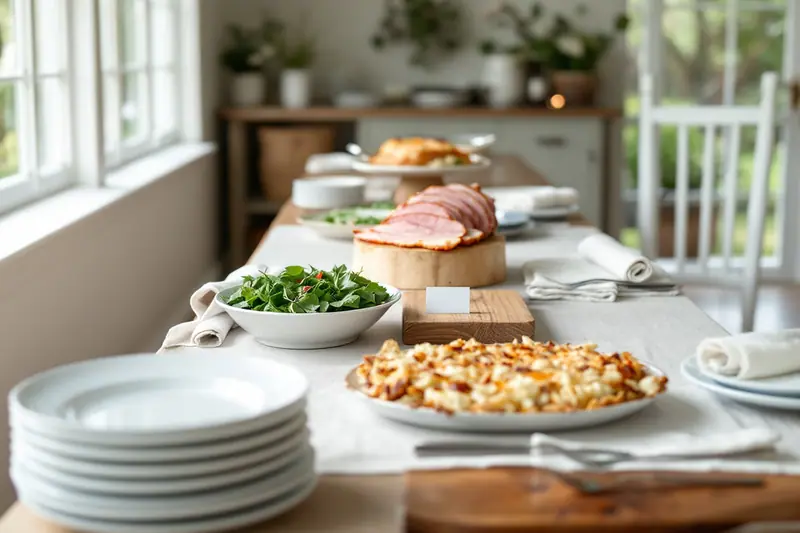
Here is the basic single-line table, described from the guest's left to right as they walk along it:
- Stack of plates.
- Salads and cold dishes.
- Vegetables and sides.
- Starches (potatoes, rice, pasta).
- The main dish, with its sauce right beside it.
- Bread and butter.
- Cutlery rolled in napkins.
That is the whole idea. Everything else is detail.
Why the plates go first and the forks go last
Plates at the start, obviously. But the cutlery belongs at the very end, wrapped in napkins, because a guest carrying a fork and knife has one less hand for serving. Rolled sets are easy to grab with the plate already in the other hand, and they keep the table tidy.
The order of dishes matters for two reasons. Inexpensive and abundant food goes first because people fill their plates early in the line, then become more careful as they see how much is left. Putting the salad and sides before the main means guests take a reasonable portion of the roast, not a heaping one, and your expensive dish lasts longer. Second, anything with a sauce or gravy should be near the end, so it goes on top and does not run into everything else as the plate travels.
Put bread after the main so it can sit on top of the plate. If you put the rolls first, every second guest will stack the main dish on a roll and wonder where the bread went.
When to run a double-sided line
A single line serves about 50 guests in 15 to 20 minutes if the table is well set. Past 50 or 60, or if you want everyone eating within a quarter of an hour, set the table in the middle of the room and run a line down each side.
In words, the double-sided table looks like this: a long table, plates stacked at the same end on both sides, and every dish either duplicated (one on each side) or set down the center line where both sides can reach it with a long-handled spoon. Each side moves in the same direction. At the far end, the two lines peel off left and right to the cutlery and napkins, which sit on a small separate table or at both corners.
For a hundred guests I run two double-sided tables, which gives four lines and gets everyone through in about 20 minutes. A party the size of the fall wedding dinner for 85 is the point where I would set up two lines and leave the cake waiting on its own table.
How much table length each dish needs
The question no one asks until the table is too short. My working numbers:
| Item | Table length needed |
|---|---|
| Stack of plates | 12 inches |
| Large platter or bowl | 15 to 18 inches |
| 9-by-13 baking dish | 15 inches (with space for its spoon) |
| Full-size chafing dish | 24 inches |
| Basket of rolls with butter | 12 inches |
| Cutlery and napkins | 12 to 18 inches |
| Space for setting a plate down | 6 inches at every 2 or 3 dishes |
Add them up. A modest buffet of plates, two salads, two sides, one main, rolls and cutlery needs about 8 to 9 feet of table, which means two standard 6-foot folding tables pushed together and a bit of breathing room at each end. A single 6-foot table looks like enough until you try to fit it all on.
Guests need somewhere to put the plate down for a moment while they use both hands for a spoon and a pair of tongs. Leave that 6-inch gap after every second or third dish.
Serving utensils, one per dish
Every dish gets its own serving utensil, and the utensil rests on a small plate or spoon rest beside the dish, not in it. A spoon left in a casserole slides in and sinks; a spoon left on the tablecloth leaves a stain.
My matching list:
- Tongs for salad, sliced meat, roasted vegetables and anything in pieces.
- A large slotted spoon for anything sitting in liquid.
- A solid serving spoon for casseroles and mashed potatoes.
- A ladle for gravy, soup or sauce.
- A cake server or pie server for anything cut in squares.
Count your utensils the week before. Most of us have fewer tongs than we think. If the buffet is long, add a second utensil for the dishes people will take most of, like the main and the potatoes, so two guests do not wait for one spoon.
Labels on every dish
Small folded cards in front of each dish save more time than anything else on the table. Each one should name the dish in plain words and add one line for anything a guest needs to know: "contains nuts," "vegetarian," "gluten free," "shellfish." Guests with allergies otherwise stop the line to ask, and there is never anyone nearby who knows.
Write them the day before. I use plain white cards folded in half and a dark marker, and I keep a few blanks for last-minute substitutions.
Height and risers
A flat table of flat dishes looks like a cafeteria and is harder to reach across. A few risers near the back of the table give it shape and keep the reach short.
You can buy risers, but I use what is in the house: sturdy boxes, upturned baking pans, a stack of books, a wooden crate, all draped with the tablecloth or a second piece of linen. Put the tallest things at the back and the lowest at the front. Raise bread baskets, cold platters and anything that is mostly looked at. Never raise hot dishes, soups or anything with a ladle; those stay low and steady at the front edge.
On a double-sided table, keep the height in the center line so both sides can see across it.
Replenishing without stopping the line
Have a second pan of each main dish ready in the kitchen, and a person who is in charge of watching the table. When a dish is about a third full, swap the whole dish rather than scraping one into another in front of the guests. It is faster, it looks better, and it keeps food that has been sitting out from mixing with fresh food.
Hot dishes that have been out for two hours come off the table, full stop. The same goes for cold dishes. Keeping hot food at 140°F (60°C) or above in chafing dishes and cold food at 40°F (4°C) or below over ice gives you more room, but the two-hour limit is still the one I use for anything at room temperature.
Where the drinks and dessert go
Drinks never go on the food table. They slow the line, they spill, and they make people juggle. Set a separate drink table across the room or at least 10 feet from the end of the buffet, so the people pouring are not blocking the people eating. Put ice, glasses, water and a place for empties there. If you are also passing hors d'oeuvres, as described in the guide to passed hors d'oeuvres, the drinks table is where servers can pick up empty glasses on their way back to the kitchen.
Dessert gets its own table too, and it goes out only after the main buffet has been cleared or is nearly finished. Clearing the main table and setting dessert out in the same spot is the signal that dinner is over. If there is no room for a second table, clear the main table entirely, change the tablecloth if needed, and bring out plates, desserts and forks in the same left-to-right order.
A buffet checklist
A week ahead
- Sketch the table on paper with every dish, utensil and card.
- Count plates (1 1/2 per guest), cutlery, napkins, serving utensils and spoon rests.
- Borrow or rent extra tables, chafing dishes and risers.
The day before
- Set up the tables in place and cover them.
- Put empty serving dishes on the table where they will go, each with a sticky note naming the dish.
- Write the food cards.
- Roll cutlery in napkins.
The morning of
- Fill ice bins and chill cold platters.
- Set out risers and drape them.
- Set the drink table.
Thirty minutes before
- Light chafing dish fuel and fill water pans.
- Bring out cold dishes last, just before the line opens.
During
- One person watches the table and swaps dishes.
- Pull anything that has been out two hours.
If you want the quantities for the food itself, the guide on how much food per guest has a table for 25, 50 and 100. I tape the paper sketch to the wall behind the buffet, so whoever is helping knows exactly where the second pan of potatoes goes when the first one runs low.
Topics: Menus & Planning | Kitchen Craft

Lorna has cooked for church suppers, family reunions and a good many backyard weddings in the Connecticut River valley. She writes about menus, quantities and keeping a party on schedule.