Hosting with Drop-Off Catering: Amounts, Setup and Food Safety
Drop-off catering is the friendliest kind of help a host can hire. Someone else cooks, a van pulls into the driveway, and two people carry in foil pans and a bag of serving utensils that may or may not match. Then they leave, and the rest is up to you. Spring is full of the kind of parties where this makes sense: showers, christenings, first communions, a retirement lunch, the open house after a memorial service. The food arrives ready. The hosting does not. Here is how to fill the gap between the van and the buffet.
If you are still deciding between catering styles, the guide to food-only catering explains what is and is not included, and how it differs from full service with staff.
Ordering the right amounts
Caterers quote by the person, and most of them are honest about portions. Still, a caterer's "serves 20" assumes the dish is one of several, and assumes guests are polite. Your uncles may not be polite.
Here is how I check a drop-off order for 40 guests at a lunch buffet with no other meal served that afternoon.
| Item | Per guest | For 40 | What to order |
|---|---|---|---|
| Main protein (chicken, salmon, sliced beef) | 5 to 6 oz cooked | 13 to 15 lb | 2 large pans, or 1 large and 1 half |
| Starch (pasta, potatoes, rice, grain salad) | 4 to 5 oz | 10 to 12 lb | 2 half pans |
| Vegetable side | 3 to 4 oz | 8 to 10 lb | 2 half pans |
| Green salad | 1 1/2 cups loose | 4 to 5 large bowls of greens | 1 large bowl, dressing on the side |
| Rolls or bread | 1 1/2 pieces | 60 | 5 dozen |
| Dessert (bars, cookies, cake) | 2 pieces or 1 slice | 80 small pieces | 7 dozen bars |
Two rules on top of the numbers. First, order one extra pan of whatever is the cheapest filling dish (usually pasta or a grain salad). That is your insurance, and it costs less than running out of chicken. Second, ask whether a vegetarian main is included, and if not, add one sized for a quarter of the guests. Vegetarians eat the main, and so does everyone who thinks it looks good. The full set of tables by course and event type is in the guide to how much food per guest.
Ask the caterer three questions when you order: Does the food arrive hot or cold? Are serving utensils and chafing setups included, and do they need to come back? What time is the drop-off window? A window of "between 10 and 12" for a noon party is not a window. Ask for 60 to 90 minutes before guests arrive.
What to have ready before the van arrives
The morning of, the delivery takes about five minutes. Have this ready so those five minutes are not chaos.
Platters and bowls
Pull out one serving piece for every dish on the order, plus two spares. Set them on the buffet table with a sticky note on each saying what goes there. This is my favorite trick and I will defend it forever. It means anyone who helps you can plate the food correctly, and it shows you right away that you are short a platter for the roasted carrots.
Chafing dishes and fuel
If hot food comes in disposable aluminum pans, you will need wire chafing racks (often included) and fuel cans. Each standard fuel can burns about 2 hours; for a four-hour party, you need two per rack plus spares. A long-burn can lasts about 6 hours. Have a long lighter, not matches. Put a heatproof board or a folded towel under each rack if the table is good wood.
Serving spoons
One per dish, plus tongs for salads and rolls, a pie server for anything cut in squares, and a small ladle for dressings. Caterers send plastic spoons that bend in a firm potato salad. Use your own.
Ice and cold holding
A big cooler or a clean sink full of ice for drinks. A second container of ice for cold platters if the party is outdoors or the room is warm. Two bags of ice for every 20 guests is a sane starting point.
Space in the refrigerator
Clear a shelf the night before. Cold platters (salads, shrimp, cut fruit, dessert with cream) go straight in when they arrive.
Small things
Trash bags, paper towels, a roll of foil, plastic wrap, labels and a marker, an instant-read thermometer, and oven mitts in a place you can find them.
Receiving and holding food safely
When the food arrives, check it. Hot food should be hot, at 140°F (60°C) or above. Cold food should be cold, at 40°F (4°C) or below. An instant-read thermometer in the middle of a pan takes five seconds. If something arrives lukewarm, call the caterer while the driver is still in the driveway.
Then hold it correctly until it is served.
- Hot food that will be served within 30 minutes can go straight into lit chafing dishes.
- Hot food arriving more than an hour early should go into the oven, covered, at 200°F (95°C) to keep it above 140°F (60°C). Do not put it in at 350°F (175°C) or the edges will dry out by noon.
- Anything that arrived cold and is meant to be served hot should be reheated to 165°F (74°C) before it goes on the buffet.
- Cold platters stay in the refrigerator until ten minutes before guests arrive.
Once food is on the buffet, the 2-hour rule applies: perishable food should not sit between 40°F (4°C) and 140°F (60°C) for more than two hours, or one hour if the room or porch is above 90°F (32°C). The guide to keeping party food safe explains the reasoning and how to hold platters over ice.
Plating it to look homemade
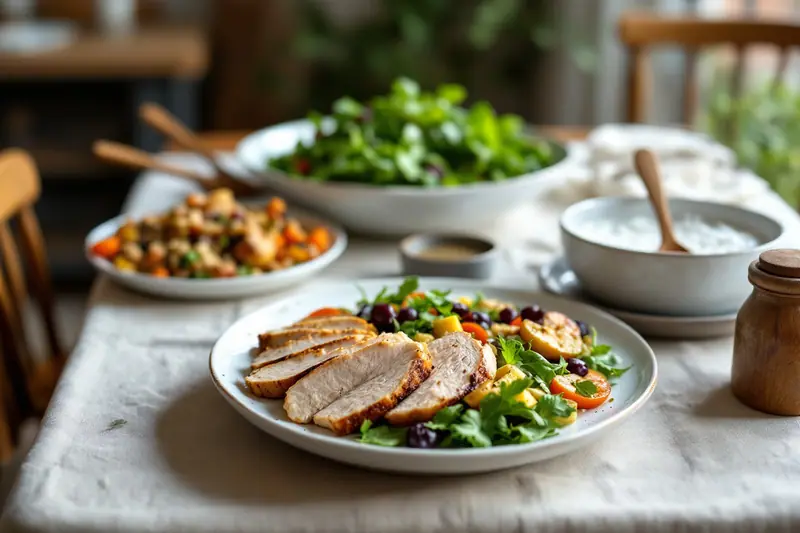
There is nothing wrong with a caterer's foil pan. But put the same food on your own dishes and the table looks like a party instead of a conference break room.
Here is what changes the look most for the least work.
- Move every dish out of its container into your own serving pieces, except the hot food in chafing setups. For those, nest the foil pan inside your own deeper roasting pan or a nice baking dish if it fits.
- Do not fill platters to the edge. Fill them two-thirds and keep the rest back for refills. A half-empty platter looks sad; a modestly filled one that gets topped up looks generous.
- Slice or fan the main. Sliced beef or chicken looks better shingled in a line down a long platter than piled in a heap.
- Garnish once, simply. A handful of chopped parsley over potatoes, a few lemon wedges by the salmon, some whole herb sprigs at the corner of a meat platter. Do not use garnish you would not eat.
- Dress the green salad at the last minute, and only half of it. Dress the second half when you refill.
- Put bread in a basket lined with a cloth napkin.
- Plate dessert last, on a separate table or the cleared buffet.
If the caterer sends a printed label on each pan, peel it off before serving. Then decide how to label the dishes yourself. I use small folded cards with the dish name and any common allergens ("contains nuts", "made with dairy"). Guests with allergies will ask anyway, but the cards save you answering forty times.
Who refills
This is the part nobody plans and everybody notices. Without staff, someone has to watch the buffet. If it is you, you will spend the party in the kitchen.
Pick a person, ahead of time, who agrees to check the buffet every 15 to 20 minutes for the first hour, then every half hour. Give them a short list.
- Top up platters from the kitchen, never by pouring fresh food onto a platter that has been out more than an hour. Swap in a fresh platter instead.
- Change the chafing fuel when the flame drops (check at the 90 minute mark).
- Wipe up drips, and put out more napkins and forks.
- Tell the host when anything is down to its last refill.
A teenager who is paid in cash and leftover dessert is often excellent at this. So is an aunt with opinions. For more on table flow and where to put the plates, the buffet setup guide is worth a look before the day.
Cleanup and leftovers
Two hours after the food goes out, decide what is done. Hot food that has been held above 140°F (60°C) the whole time can stay longer, but cold platters that have been sitting at room temperature should come off at two hours and be thrown out, not saved. That rule applies to the shrimp. It is painful. Do it.
For everything else:
- Pack leftovers into shallow containers, no deeper than 2 inches, so they cool fast. Get them into the refrigerator within two hours of when they came off heat.
- Label with the date. Leftovers keep 3 to 4 days in the refrigerator.
- Send food home with guests in containers you do not need back. Buy a sleeve of takeout containers for this. People are delighted to leave with a lunch.
- Rinse and stack any equipment that goes back to the caterer, and put it by the door with the pickup time written on a note on top.
Wait until the fuel cans are completely cool before throwing them away. Put them in a metal bucket if you are unsure.
A morning-of timeline
For a noon lunch with a 10:30 drop-off:
| Time | What happens |
|---|---|
| 8:30 | Buffet table set, labeled platters and serving spoons in place |
| 9:30 | Drinks on ice; refrigerator shelf cleared for cold platters |
| 10:30 | Food arrives. Check temperatures. Cold into the refrigerator, hot into a 200°F (95°C) oven |
| 11:15 | Light chafing fuel; plate the room-temperature dishes |
| 11:45 | Hot food into chafing dishes; cold platters out; dress half the salad |
| 12:00 | Guests arrive |
| 12:30 | First refill check |
| 1:30 | Change fuel; dessert out |
| 2:00 | Cold platters off; leftovers packed |
The party will go on without you after that. Put a pot of coffee on, sit down with a plate of whatever is left on the dessert table, and let someone else carry the empty pans to the car.
Topics: Menus & Planning | Kitchen Craft

Tomoko grew up in a family that entertained constantly, in Connecticut and later in Boston. She writes about hors d'oeuvres, party platters and the kitchen habits that keep food safe for a crowd.