Maple Pecan Pie in a Lemon Butter Crust for Thanksgiving
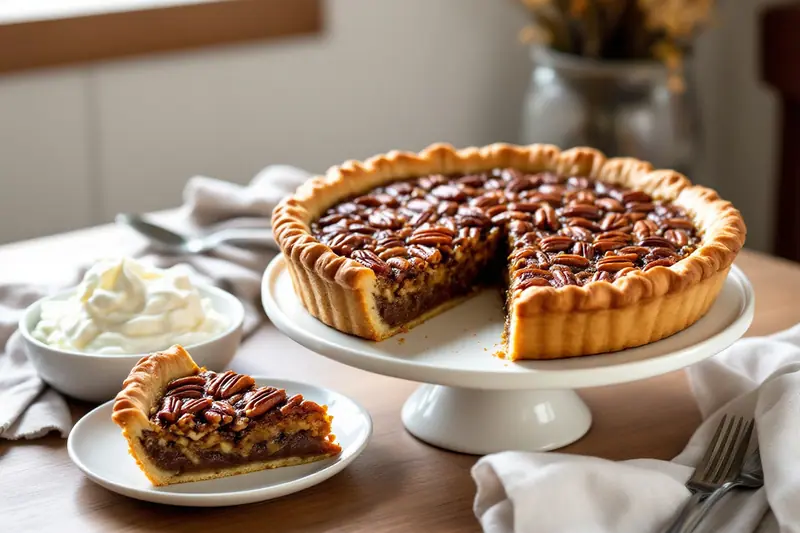
Most pecan pies lean on corn syrup, which gives them that tall, wobbly, very sweet filling. This one uses pure maple syrup and light brown sugar instead, and the difference is real. The filling sets a little softer and tastes of caramel and wood smoke rather than plain sugar. A splash of golden rum and a spoonful of vanilla round it out, and grated lemon zest in both the filling and the crust keeps the whole thing from tipping into cloying. It is the pie I bring when someone asks for "something Yankee" on the Thanksgiving table.
The crust deserves its own mention. It is a short, tender butter pastry bound with an egg yolk and a little lemon juice. The yolk makes it easy to roll and less likely to shrink, and the acid keeps it tender. Because the filling is rich, a crust with a bit of brightness in it makes every bite feel lighter than it is.
Choosing the maple syrup
Maple syrup is sold by color and flavor, and the grade matters more in a pie than on pancakes, because baking dulls delicate flavors.
| Grade | Color and taste | In this pie |
|---|---|---|
| Grade A Golden, Delicate Taste | Pale, light, buttery | Too mild; the flavor disappears in the oven |
| Grade A Amber, Rich Taste | Medium amber, rounded | A good, reliable choice |
| Grade A Dark, Robust Taste | Deep amber, strong maple | My first choice for baking |
| Grade A Very Dark, Strong Taste | Nearly molasses-colored | Use half and half with Amber, or it can taste bitter |
Whatever you buy, it must be pure maple syrup. Pancake syrup is mostly corn syrup with flavoring and will make a sticky, one-note pie.
The crust: chill twice, bake blind
This crust gets two rests in the refrigerator. The first, at least three hours or overnight, lets the flour hydrate and the butter firm up so the dough rolls cleanly. The second, after it is crimped in the pan, sets the shape so the high edge does not slump in the oven.
The pie is partly baked before the filling goes in. A wet, eggy filling sitting on raw dough makes a pale, soggy bottom, and maple fillings are especially prone to it. Line the chilled shell with foil or parchment, fill it with pie weights or dried beans, and bake until the edges are set, then remove the weights and give it a few minutes more until the bottom looks dry and faintly golden.
How to tell when it is done
Maple fillings set more gently than corn syrup ones, so the usual "firm all the way across" test will overbake it. Look for the edges to be puffed and set and the center to be slightly domed, with a small wobble right in the middle when you nudge the pan, like gelatin rather than liquid. An instant-read thermometer in the center should read about 200°F (93°C). The filling finishes setting as it cools, which takes at least 3 hours on a rack. Cut it warm and it will run.
From the recipe box
Maple pecan pie with lemon butter crust
One 9-inch deep pie
- Prep
- 40 min
- Cook
- 1 hr
- Rest
- 3 hr
- Total
- 4 hr 40 min
Lemon crust
- 1 1/3 cups165 g all-purpose flour
- 2 tbsp25 g granulated sugar
- 1/4 tsp1 ml fine salt
- 1 stick113 g cold unsalted butter, cut in pieces
- 2 tsp10 ml finely grated lemon zest
- 1 large1 large egg yolk
- 1 tbsp15 ml fresh lemon juice
- 1 to 2 tbsp15 to 30 ml ice water
Maple filling
- 6 tbsp85 g unsalted butter, softened
- 3/4 cup160 g packed light brown sugar
- 1/2 tsp2.5 ml fine salt
- 3 large3 large eggs, at room temperature
- 1 tbsp8 g all-purpose flour
- 1 cup240 ml pure maple syrup, Grade A Dark or Amber
- 3 tbsp45 ml golden rum
- 1 tsp5 ml vanilla extract
- 1 tsp5 ml finely grated lemon zest
- 2 1/2 cups250 g toasted pecans, coarsely chopped
- 1 cup100 g pecan halves for the top
Method
- Pulse the flour, sugar and salt in a food processor, add the butter and lemon zest and pulse until the mixture looks like coarse meal.
- With the machine running, add the yolk, lemon juice and just enough ice water for the dough to clump; press it into a disk, wrap it and chill at least 3 hours or up to 1 day.
- Roll the dough on a floured counter to a 12-inch round about 1/8 inch thick, fit it into a 9-inch pie pan with 1 1/2-inch sides, fold the overhang under and crimp a high edge, then chill 1 hour.
- Heat the oven to 425°F (220°C) with a rack in the lower third, prick the shell all over, line it with foil and fill with pie weights.
- Bake 12 minutes, lift out the foil and weights and bake 5 to 7 minutes more until the bottom looks dry and pale gold; cool on a rack and lower the oven to 350°F (175°C).
- Beat the softened butter until light, add the brown sugar and salt and beat until fluffy, about 2 minutes.
- Beat in the eggs one at a time, then the flour, maple syrup, rum, vanilla and lemon zest; the mixture may look curdled, which is fine.
- Fold in the chopped pecans, pour the filling into the crust and arrange the pecan halves in a ring around the edge.
- Set the pie on a foil-lined rimmed baking sheet and bake 40 to 50 minutes, until the edges are set and the center is slightly puffed with only a small wobble.
- Cool on a rack at least 3 hours before slicing, and serve with lightly sweetened whipped cream flavored with rum and vanilla.
Notes from the kitchen
- If the crust edge browns before the filling is set, cover it with a ring of foil for the last 15 minutes.
- Toast the pecans at 350°F (175°C) for 8 to 10 minutes, until fragrant, and cool them before chopping.
A Thanksgiving baking schedule
Thanksgiving ovens are crowded, so I move the pie as far forward as the pie allows.
- Sunday or Monday: make the crust dough and refrigerate it, or freeze it for up to a month. Toast the pecans and store them airtight.
- Tuesday: roll, crimp and chill the shell. Blind-bake it in the afternoon.
- Wednesday morning: fill and bake the pie. Cool it on a rack, then cover loosely and keep it in a cool room or the refrigerator.
- Thursday: take it out of the refrigerator two hours before dessert so the filling softens and the flavor opens up. Whip the cream just before serving.
A baked pie keeps well for two days covered in the refrigerator. I do not freeze the finished pie; the filling weeps a little when it thaws.
If something goes wrong
- The filling cracked across the top: it baked a few minutes too long or too hot. It still tastes fine; a ring of whipped cream piped over the crack hides it.
- The center is still liquid after cooling: the pie came out too early. Return it to a 325°F (165°C) oven for 10 to 15 minutes, then cool it again completely.
- The bottom crust is pale and damp: the shell needed a few more minutes of blind baking. Next time, bake it until the bottom looks dry, not just set at the edges.
- The pecans on top look dark: tent the pie loosely with foil after the first 25 minutes.
Scaling for a crowd
A 9-inch deep pie cuts into 10 slices, and with a filling this rich, thin slices are the right size. For a large family gathering, plan on one pie for every 8 to 10 guests if it is the only dessert, and one for every 14 to 16 if it shares the sideboard with apple and pumpkin. For 30 people with three kinds of pie, two maple pecan pies is plenty.
Make each pie separately. The filling can be doubled in one bowl without trouble, but rolling and crimping two shells is easier one at a time while the second disk of dough stays cold.
Variations and serving
For a less boozy pie, replace the rum with an equal amount of strong brewed coffee, which deepens the maple without adding sweetness. Walnuts work in place of half the pecans for a slightly more bitter, old-fashioned edge. A handful of chopped bittersweet chocolate folded into the filling turns it into a different pie altogether, but a good one.
Serve it at cool room temperature with whipped cream flavored with a spoonful of rum, a little powdered sugar and vanilla. If you want something lighter to finish a heavy meal, a small glass of the chocolate mousse from mud season sits well beside a sliver of pie. Other autumn baking and holiday dishes live under The Seasonal Table, and the full run of monthly dishes is in the recipe archive.
Topics: Cakes & Baking | The Seasonal Table

Abigail bakes the cakes, pies and bread for her family's celebrations in western Massachusetts. She writes about layer cakes, crusts, quick breads and baking ahead.