Brown Irish Soda Bread with Currants and Fennel
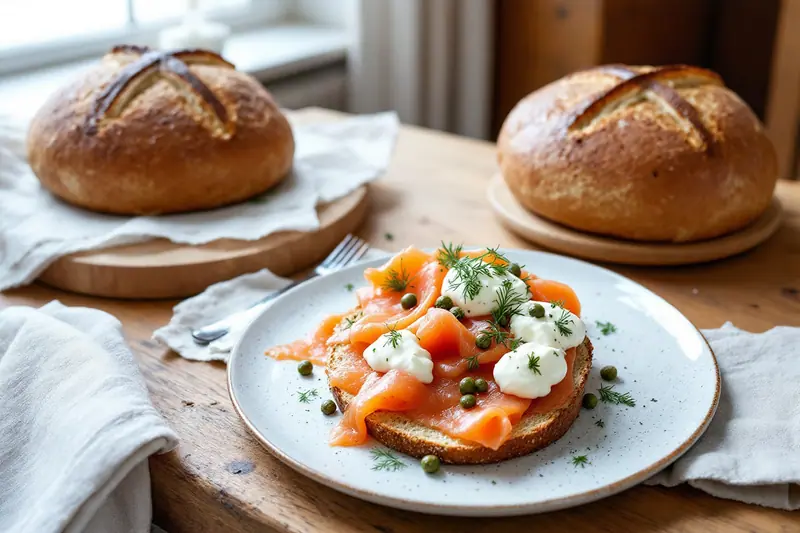
A brown soda bread is the quickest real bread you can make. There is no yeast, no rising and no kneading to speak of: buttermilk and baking soda do the lifting, and the loaves go into the oven about fifteen minutes after you start measuring. This one is made mostly with whole wheat flour, with a smaller share of all-purpose for lightness, and enriched with eggs and melted butter so the crumb stays moist for days. A spoonful of sugar takes the edge off the wheat. Currants and crushed fennel seed are optional, and I use both more often than not.
It is a bread for slicing thin. The dense, nubbly crumb holds a smear of cream cheese and a fold of smoked salmon without collapsing, which makes it my standard for a winter party platter. It is also very good toasted for breakfast with salted butter and marmalade.
The flour mix
The recipe uses three parts whole wheat flour to one part all-purpose. That ratio gives a bread that tastes properly wheaty and brown but still rises enough to slice cleanly. All whole wheat makes a heavier, crumblier loaf; if you want to try it, add an extra 1/4 cup of buttermilk, because whole wheat absorbs more liquid.
Whole wheat flour comes in different grinds. A coarse, stone-ground flour gives the traditional rough, nutty crumb. Fine whole wheat bakes up softer and more even. Either works. Whole wheat flour goes stale faster than white, so smell it before you bake: it should smell sweet and nutty, never bitter or like old paint.
Buttermilk and soda
Soda bread rises because the acid in buttermilk reacts with baking soda the moment they meet, releasing carbon dioxide. That reaction starts right away, so have the oven fully heated and the pans or baking sheet ready before you add the wet ingredients. Once the dough is mixed, shape it and get it into the oven within five minutes or so.
Real cultured buttermilk gives the best flavor and the most reliable rise. In a pinch, stir 2 tablespoons of lemon juice into each cup of whole milk and let it stand 10 minutes, but the bread will be a little flatter.
Mix gently
The dough is wet and sticky, closer to a thick batter than bread dough. Mix it with a rubber spatula until no dry pockets remain, then finish with floured hands, but stop there. Overworking soda bread develops gluten and makes it tough and rubbery. On a well-floured board, a few folds are enough to bring each half into a rough round.
The cross cut deep into the top is practical as well as traditional. It lets heat reach the dense center so the loaf bakes through, and it gives the bread natural quarters to break into.
From the recipe box
Brown Irish soda bread with currants and fennel
2 round loaves
- Prep
- 15 min
- Cook
- 50 min
- Rest
- 1 hr
- Total
- 2 hr 5 min
Dry ingredients
- 6 cups720 g whole wheat flour
- 2 cups250 g all-purpose flour, plus more for the board
- 2 tbsp25 g granulated sugar
- 1 3/4 tsp9 ml fine salt
- 2 tsp10 ml baking soda
- 1 1/2 tsp7.5 ml baking powder
- 1 cup140 g dried currants (optional)
- 2 tbsp30 ml whole fennel seed, coarsely crushed (optional)
Wet ingredients
- 3 1/2 cups840 ml buttermilk
- 3 large3 large eggs
- 6 tbsp85 g unsalted butter, melted and slightly cooled, plus more for the sheet
Method
- Heat the oven to 375°F (190°C) with a rack in the center and butter a large baking sheet or line it with parchment.
- Crush the fennel seed in a mortar, or seal it in a sturdy bag and roll it firmly with a rolling pin until most seeds are cracked.
- Whisk the whole wheat flour, all-purpose flour, sugar, salt, baking soda, baking powder, currants and fennel in a large bowl until evenly mixed.
- Whisk the buttermilk and eggs together in a large measuring cup, then whisk in the melted butter.
- Pour the wet ingredients into the flour mixture and stir with a rubber spatula until no dry flour remains, finishing with floured hands if needed.
- Turn the sticky dough onto a well-floured board, divide it in half and fold each half over on itself 3 or 4 times to form a round about 7 inches across.
- Set the rounds on the sheet at least 4 inches apart and cut a deep cross into each top, about 1 inch deep, with a floured knife.
- Bake 45 to 55 minutes, until the loaves are deep brown, sound hollow when tapped underneath and read about 200°F (93°C) in the center.
- Cool on a rack at least 1 hour before slicing, wrapped in a clean towel if you want a softer crust.
Notes from the kitchen
- For loaf pans, use two buttered 10-by-5-inch pans and bake 40 to 50 minutes; the long shape slices neatly for canapes.
- Wrapped well, the loaves freeze for up to 2 months; thaw overnight at room temperature, still wrapped.
Shapes and pans
Free-form rounds are traditional and give the most crust. For a party platter, though, a long loaf baked in a pan slices into neat, even rectangles that look tidy under smoked salmon. Use two 10-by-5-inch pans, or the longest loaf pans you have, buttered well. Smaller 9-by-5-inch pans are too small for this quantity; the dough will rise over the sides. In pans, start checking at 40 minutes.
Making ahead
Soda bread is at its best the day it is baked, but this one, with its eggs and butter, holds up better than most. Wrapped in a towel and then in foil, it stays good for 2 days at room temperature. For a party I bake the loaves the day before, cool them completely, and wrap them. Thinly sliced bread dries out quickly, so slice it no more than an hour before guests arrive and keep the slices covered with a damp towel or plastic wrap.
For longer storage, freeze the cooled loaves whole, wrapped in plastic and then foil. They thaw in about 4 hours at room temperature. Refresh a thawed loaf in a 325°F (165°C) oven for 10 minutes before slicing.
Serving with smoked salmon for a party
This is how I set up a smoked fish platter for a winter open house.
- Slice the bread about 1/4 inch thick and cut large slices in half.
- Spread each piece with softened cream cheese, or set out a bowl of it with small knives.
- Lay a thin fold of smoked salmon or home-cured gravlax on top.
- Finish with any of: chopped fresh dill, capers, thinly sliced red onion, a few drops of lemon, a dab of sweet mustard sauce.
One loaf yields about 24 thin slices, or 40 to 48 half-slice canapes. For a cocktail party where this is one of several hors d'oeuvres, plan on 2 to 3 pieces per guest:
| Guests | Canapes | Loaves | Smoked salmon | Cream cheese |
|---|---|---|---|---|
| 20 | 50 | 1 1/2 | 1 1/4 lb (560 g) | 12 oz (340 g) |
| 40 | 100 | 2 to 3 | 2 1/2 lb (1.1 kg) | 1 1/2 lb (680 g) |
| 60 | 150 | 4 | 3 3/4 lb (1.7 kg) | 2 1/4 lb (1 kg) |
Smoked fish and cream cheese should stay chilled. Assemble a tray of 20 or 30 at a time and replace it rather than setting out the whole batch at once, and keep each tray out no more than 2 hours. The bread also suits a spread of salmon mousse on a holiday buffet.
Variations
Leave out the currants and fennel for a plain brown loaf to serve with soup or a cheese board. Caraway seed is the classic alternative to fennel. A handful of rolled oats, sprinkled over the top before baking, gives a pretty, rustic crust. For a sweeter breakfast bread, add the grated zest of an orange and use raisins instead of currants. If you like baking bread for gatherings, the braided challah is the yeasted counterpart to this one: slower, richer, and just as good for a holiday table.
Topics: Cakes & Baking

Abigail bakes the cakes, pies and bread for her family's celebrations in western Massachusetts. She writes about layer cakes, crusts, quick breads and baking ahead.