Challah Bread: Braided Egg Loaves, Round Raisin Version
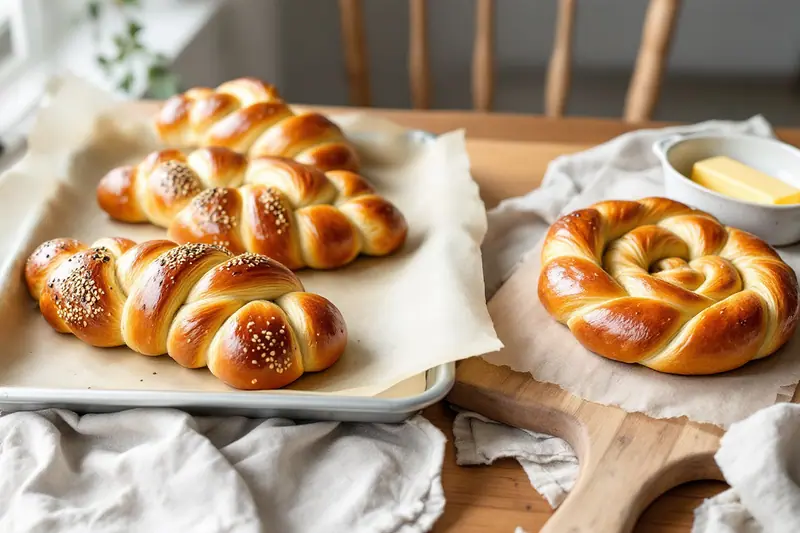
A good challah is the bread that makes people tear off a second piece before the meal starts. It is rich with eggs and oil, gently sweet, and its crumb pulls apart in long, soft feathers under a deep brown, shining crust. In Jewish households it is the bread of the Sabbath table and of holidays, and it turns up at weddings and other celebrations too. This recipe makes enough dough for three generous loaves or one very large one, and in the autumn I shape part of it into round loaves studded with raisins, as many families do for the new year. It is not hard bread to make. It mostly asks for patience and a warm corner.
What goes into the dough
The ingredients are simple: yeast, warm water, eggs, sugar, vegetable oil, salt and all-purpose flour. Oil rather than butter keeps the bread dairy-free, which matters for many families who serve it with a meat meal, and it gives a softer, longer-keeping crumb. The eggs give the color and the richness. All-purpose flour makes a tender loaf; bread flour gives a chewier, taller one, and either is fine.
Flour amounts are a range for a reason. On a damp autumn day the dough takes more; in a dry, heated kitchen in winter it takes less. Add the last cups gradually, and stop when the dough pulls away from the sides of the bowl and feels soft and slightly tacky, like the inside of your wrist. A dough that is stiff and dry will make a dense, cracked loaf.
Rising, and how to fit it into your day
The dough rises twice: once until doubled, about 1 1/2 hours in a 75°F (24°C) kitchen, then again after you punch it down, about 45 minutes. If your day gets away from you, cover the bowl tightly after the first rise and refrigerate it overnight. The cold slows the yeast and develops a deeper flavor. In the morning, let the dough sit at room temperature for about an hour, until it no longer feels cold in the center, before you divide and braid. Cold dough tears when you roll strands.
Braiding
Three strands is the place to start. Roll each piece into a rope about 16 inches long, thicker in the middle and tapered at the ends, which gives the loaf its classic shape. Pinch the three tops together, then braid as you would hair: right over center, left over center, until you reach the end. Pinch the ends and tuck them under.
A six-strand braid looks spectacular on a holiday table and is easier than it looks. Pinch six ropes together at the top and number them 1 to 6 from left to right, counting fresh after every move. Then repeat two moves until you run out of dough: move strand 6 over strand 1 to the far left, then move strand 2 to the far right. Move strand 1 over strand 6 to the far right, then move strand 5 to the far left. Keep the tension even and don't pull hard, or the loaf will bake lopsided.
For the round autumn loaf, roll one long rope, about 30 inches, and coil it into a loose spiral on the sheet pan, tucking the end underneath at the center. Work the raisins in when you roll the rope, pressing them into the dough so they don't burn on the surface.
The egg wash
An egg beaten with a tablespoon of water gives the crust its high shine. Brush the loaves once after shaping and again just before they go into the oven, getting into the cracks of the braid. Sprinkle with sesame or poppy seeds after the second coat, or leave them plain.
From the recipe box
Challah bread
3 braided loaves or 1 large celebration loaf
- Prep
- 45 min
- Cook
- 35 min
- Rest
- 3 hr 15 min
- Total
- 4 hr 35 min
Dough
- 2 tbsp (2 packets)2 tbsp (2 packets) active dry yeast
- 1/2 cup120 ml warm water, about 105°F (40°C)
- 1 pinch1 pinch sugar, for the yeast
- 5 large5 large eggs
- 3/4 cup150 g granulated sugar
- 1/2 cup120 ml vegetable oil
- 1 1/2 cups360 ml warm water
- 1 tbsp15 ml kosher salt
- 9 to 10 cups1.1 to 1.25 kg all-purpose flour
- 1 cup150 g raisins, golden or dark (optional)
Finish
- 1 large1 large egg beaten with 1 tbsp water
- 2 tbsp18 g sesame or poppy seeds
Method
- Stir the yeast and a pinch of sugar into the 1/2 cup warm water and leave 5 to 10 minutes, until foamy.
- In a stand mixer, beat the eggs with the 3/4 cup sugar until light, then beat in the yeast mixture, oil, 1 1/2 cups warm water and salt.
- Add 3 cups flour and beat on low until smooth, then add the rest a cup at a time until the dough pulls away from the bowl and feels soft and tacky.
- Knead on a floured counter for 5 to 8 minutes, until smooth and springy, then place in an oiled bowl, cover and let rise until doubled, about 1 1/2 hours.
- Punch the dough down, cover and let rise again for about 45 minutes, or refrigerate it overnight after punching down.
- Divide the dough into thirds for three loaves, then divide each third into three ropes about 16 inches long, working in raisins now if using.
- Braid each set of ropes, tuck the ends under and set the loaves on two parchment-lined sheet pans. Brush with egg wash.
- Let the loaves rise, loosely covered, until puffy and a fingertip leaves a slow dent, 30 to 45 minutes. Heat the oven to 350°F (175°C).
- Brush again with egg wash, sprinkle with seeds and bake 25 to 35 minutes, rotating the pans halfway, until deep golden and 190°F (88°C) in the center.
- Tent with foil if the crust browns too fast. Cool on a rack at least 30 minutes before slicing.
Notes from the kitchen
- For one large loaf, braid the whole batch and bake at 325°F (165°C) for 50 to 60 minutes, tented after 25 minutes.
- Wrapped loaves freeze well for up to 1 month.
One big celebration loaf
For a wedding, a family milestone or a large holiday table, the full batch makes one impressive loaf about 20 inches long. Braid six thick strands, or make a three-strand braid and lay a thinner three-strand braid down its center. Bake it on a half sheet pan at 325°F (165°C) for 50 to 60 minutes, covering it loosely with foil once it is well browned, about 25 minutes in. The lower temperature lets the thick middle bake through before the outside goes too dark. Check the center with a thermometer: 190°F (88°C) means it is done.
Baking for a crowd
Sliced for a buffet, one standard loaf gives about 16 slices. As the bread for a seated dinner, count on two slices per guest; for a buffet with other breads, plan on one.
| Guests | Loaves | Batches of dough |
|---|---|---|
| 24 | 3 | 1 |
| 48 | 6 | 2 |
| 72 | 9 | 3 |
A home stand mixer handles one batch at a time, so make the batches one after another, 20 minutes apart, and stagger the rises. Most home ovens fit two sheet pans of loaves at once; rotate top to bottom halfway through. For a big event, bake the day before, cool completely and wrap well. Or bake a week or two ahead and freeze, then thaw overnight in their wrapping and warm at 325°F (165°C) for 10 minutes.
Serving
Challah is traditionally torn by hand at the table, and it is best the day it is baked, with nothing on it at all. By the second day it makes wonderful French toast, and by the third, a rich bread pudding. If you are planning a whole autumn holiday table, the Vermont apple pie and an empress rice pudding both work well after a big meal, and more baking for gatherings is collected under Cakes and Baking. Keep one loaf back for yourself. The heel, still warm, is the baker's share.
Topics: Cakes & Baking

Abigail bakes the cakes, pies and bread for her family's celebrations in western Massachusetts. She writes about layer cakes, crusts, quick breads and baking ahead.