Wedding Cake Servings: Tier Sizes for 50, 100 and 150 Guests
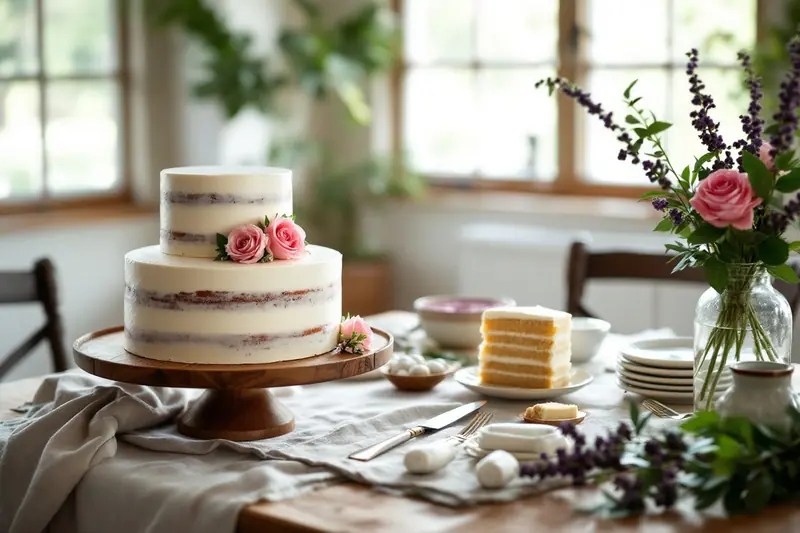
Every June someone asks me how big a wedding cake has to be, and every June the answer starts with a question back: how big is a slice? The number of people a cake feeds depends less on the cake than on the knife. A tier that serves 24 at a wedding serves about 16 at a birthday party, and that difference is where most cake budgets and most cake panics come from.
What follows are the serving counts I bake by, tier combinations for three common guest counts, the kitchen sheet-cake trick that saves a great deal of work, how to cut a tiered cake so the counts actually come out right, and how to keep buttercream standing up straight in a warm barn in July.
Wedding slice versus party slice
A wedding slice is about 1 inch wide, 2 inches deep and as tall as the tier, which for a standard tier is about 4 inches (two layers with filling). It looks narrow on the plate, but after a full dinner it is plenty, and it is the slice nearly every serving chart is built on.
A party slice is about 1 1/2 inches wide, 2 inches deep and the same 4 inches tall. That is the piece you would serve at a birthday or a shower, where cake is the main event.
So the same tier gives roughly a third fewer party slices than wedding slices. Decide which one you are cutting before you decide on tier sizes, and tell whoever is doing the cutting.
All the numbers below assume tiers about 4 inches tall. A single 2-inch layer serves half as many.
Servings per tier
Round tiers
| Tier diameter | Wedding slices | Party slices |
|---|---|---|
| 6 inch | 12 | 8 |
| 8 inch | 24 | 16 |
| 10 inch | 38 | 26 |
| 12 inch | 56 | 38 |
| 14 inch | 78 | 52 |
| 16 inch | 100 | 68 |
Square tiers
| Tier size | Wedding slices | Party slices |
|---|---|---|
| 6 inch | 18 | 12 |
| 8 inch | 32 | 20 |
| 10 inch | 50 | 32 |
| 12 inch | 72 | 48 |
| 14 inch | 98 | 64 |
Square tiers give noticeably more servings for the same width, because there are no curved edges to waste. If you need to feed a large crowd from a modest cake, square is the efficient choice. Round is the classic look, and most cake stands and toppers are made for it.
Tier combinations for 50, 100 and 150 guests
These are wedding-slice counts. I aim for about 10 percent more servings than guests to cover a slice dropped on the floor, a second piece for the groom's uncle, and the top tier if the couple wants to save it.
For 50 guests
- Round 6 and 10 inch: 12 + 38 = 50 servings. Tight; good if the top is cut, not saved.
- Round 6, 8 and 10 inch: 12 + 24 + 38 = 74 servings. Three tiers for a fuller look, with the top saved and still 62 to cut.
- Square 6 and 10 inch: 18 + 50 = 68 servings.
For 100 guests
- Round 8, 10 and 12 inch: 24 + 38 + 56 = 118 servings. My usual choice; save a 6-inch top separately if the couple wants one.
- Round 6, 8, 10 and 12 inch: 12 + 24 + 38 + 56 = 130 servings. Four tiers, taller and more formal.
- Square 6, 8 and 12 inch: 18 + 32 + 72 = 122 servings.
For 150 guests
- Round 6, 10 and 14 inch: 12 + 38 + 78 = 128 servings, plus a quarter sheet cake in the kitchen for about 30 more.
- Round 8, 12 and 16 inch: 24 + 56 + 100 = 180 servings. A big, heavy cake that needs good support and a sturdy table.
- Square 6, 10 and 14 inch: 18 + 50 + 98 = 166 servings.
The display tiers should step down evenly, usually by 2 or 4 inches. Jumping from 14 inches straight to 6 looks like a small hat perched on a wide drum.
Sheet cakes in the kitchen
The most useful thing I can tell anyone planning a wedding cake for a crowd: the cake on display does not have to feed everyone. A smaller tiered cake for the cutting, with plain sheet cakes of the same flavor waiting in the kitchen, is cheaper, easier to bake, far easier to transport and cuts faster.
Sheet cakes are cut in the kitchen and plated alongside slices from the display cake, and no guest knows the difference, as long as the frosting and flavor match. I bake sheet cakes as two layers in the pan size below and fill and frost them exactly like the tiers.
| Pan | Approximate wedding-size servings (2 layers) |
|---|---|
| 9 by 13 inch (quarter sheet) | 30 to 35 |
| 11 by 15 inch | 45 to 50 |
| 12 by 18 inch (half sheet) | 54 to 60 |
For 150 guests, a three-tier 6, 8 and 10 inch round (74 servings) plus a half sheet (about 55) and a quarter sheet (about 30) gives 159 servings, with three modest tiers instead of a tall heavy one. That is the plan I would choose for a backyard reception.
If you are hiring someone to bake the cake rather than doing it yourself, the cakes guide walks through what to ask about tiers, supports and delivery.
Cutting a tiered cake so the count comes out right
Cutting is where servings are won or lost. The method that gives the numbers in the charts:
- Take the cake apart. Remove the top tier and set it aside if it is being saved. Lift each tier off the one below with a wide spatula, and pull out the dowels or straws.
- Round tiers: cut a circle. Cut a circle 2 inches in from the outside edge, all the way around. Slice the outer ring into 1-inch pieces (for a wedding slice). Then cut another circle 2 inches in from the first, and slice that ring the same way. Continue until the center is about 4 to 6 inches across, which is cut into small wedges. A 6-inch tier is simply cut into 12 wedges.
- Square tiers: cut a grid. Cut straight across the tier 2 inches in from one edge. Slice that strip into 1-inch pieces. Move in another 2 inches and repeat.
- Use a long, sharp, thin knife, dipped in hot water and wiped dry between cuts. This keeps the layers clean and the filling from smearing.
- Lay slices on their sides. Each piece is 4 inches tall and 1 inch wide, so it plates best lying down, showing the layers.
Cutting wedges from the center like a birthday cake will give you about half the servings and ragged pieces. Brief the person cutting, even if that person is a cousin with a steady hand and good intentions.
The cake usually comes out once dinner is cleared. For how the dessert table fits into the room, the guide on setting up a buffet table covers where dessert goes and when it should appear.
About the box below: it links to a shop or service we think fits this page. If you buy or join through it, this journal may be paid a commission, and the price stays the same for you. Our recipes and menus are never written to order.
Keeping buttercream stable in summer
June and July weddings are lovely and buttercream does not care. Butter softens at about 70°F (21°C) and starts to slide not long after. A cake sitting in a sunny tent at 85°F (29°C) for three hours will lean, sag and weep. Some habits that help:
Choose the frosting with the weather in mind
American buttercream (powdered sugar and butter) is the most stable of the butter frostings because of all the sugar. A meringue buttercream (Swiss or Italian) is silkier and less sweet, but it softens faster in the heat. For an outdoor summer wedding, I either use American buttercream or replace up to half the butter in a meringue buttercream with high-ratio vegetable shortening, which holds its shape well above butter's softening point.
Keep the cake cold until the last minute
Chill finished tiers in the refrigerator, at 40°F (4°C) or a little warmer, overnight before assembly. A cold cake sets up the frosting and makes stacking much easier. Bring it to the venue cold and keep it in the coolest room available, out of direct sun, until about an hour before serving. That hour lets the cake itself soften enough to taste good while the outside stays firm.
Mind the fillings
Custards, whipped cream and cream cheese fillings must stay cold and should not sit out more than two hours. For a summer reception I prefer jam, fruit curd with buttercream, or ganache, all of which hold better.
Support every tier
Each tier needs its own cardboard round and a set of dowels or sturdy plastic straws inside the tier below, cut level with its top. In heat, a well-supported cake might soften on the outside but will not collapse.
Keep it off the floor of the tent
Set the cake on a solid table, away from the edge, the dance floor and the speakers. Heat rises from crowded floors and so does vibration.
A last check before it leaves the kitchen
The night before, I count every tier on the serving table and the sheet cakes, write the total on a card, and tape it inside the box with the knife. Then I add the cutting diagram and the name of the dish the slices go on. When the cake goes out the next afternoon, the person cutting has everything they need, and the count comes out right.
Topics: Cakes & Baking | Menus & Planning

Abigail bakes the cakes, pies and bread for her family's celebrations in western Massachusetts. She writes about layer cakes, crusts, quick breads and baking ahead.