Rhubarb Galette with a Sweet Cookie-Dough Crust
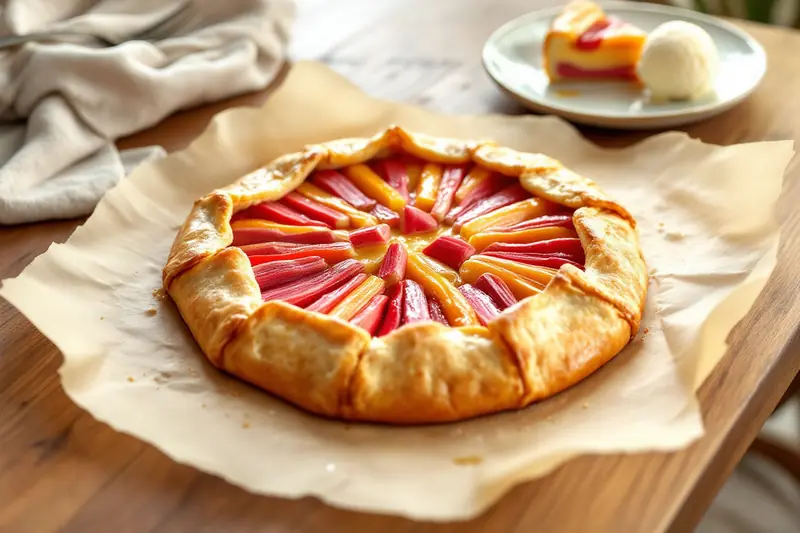
By the first week of June the rhubarb along my back fence has stopped being polite. The stalks are thick, red at the base and green toward the leaf, and there is always more of it than any one household can stew. A galette is my answer when I want something that looks like an occasion but takes about as much fuss as a batch of cookies. This one sits on a crust that is closer to sugar cookie dough than to pie pastry: soft butter creamed with sugar, an egg, vanilla, flour and a little baking powder. It bakes up crisp at the edges and cakey underneath, and its sweetness is exactly what tart rhubarb needs.
Why a cookie-dough crust works with rhubarb
A standard flaky pie crust is lean. It has almost no sugar, and against rhubarb it can taste like a plain cracker holding up a sour filling. A creamed crust brings its own sweetness and a little richness from the egg, so the whole slice reads as balanced even though the fruit itself is only lightly sugared. The baking powder gives the dough a gentle lift where it folds over the filling, and those folded edges end up tasting a lot like the best part of a butter cookie.
The tradeoff is handling. This dough is soft and sticky at room temperature, so it has to be chilled before you roll it, and it should be rolled between sheets of parchment rather than on a floured counter. If it tears, press it back together with your fingers. Nobody will see the patch once the edges are folded in.
Freezing crusts ahead
I keep two discs of this dough in the freezer from May through July. Shape the dough into a flat round about 1 inch thick, wrap it tightly in plastic, then put it in a freezer bag with the date written on it. It keeps well for about 2 months. Move it to the refrigerator the night before you plan to bake; a frozen disc takes 8 to 12 hours to thaw enough to roll without cracking. If you forget, 45 minutes on the counter will get you there, but check it often, because once this dough gets warm it turns to paste.
You can also roll the dough into its 13-inch round, slide it onto a parchment-lined sheet pan, wrap the whole pan and freeze it flat. Then the galette goes together straight from the freezer: brush, fill, fold and bake, adding 5 minutes to the first stage.
Balancing the tartness
Rhubarb varies more than people expect. Early, thin, deep red stalks are milder and slightly floral. Thick green stalks from late June are sharper and more fibrous. I taste a raw sliver before I decide on sugar, and I use the lower amount in the recipe for red, tender rhubarb and the higher amount for the thick green kind.
Two habits matter more than the exact quantity. First, toss the rhubarb with sugar at the last moment and arrange it on the crust right away. Sugar draws out juice fast, and if the fruit sits in a bowl for 15 minutes you will pour a puddle of syrup onto your crust. Second, brush the rolled dough with egg white and let it dry for a few minutes before the fruit goes on. That thin layer acts as a seal and keeps the bottom from going soggy.
The finishing touch is a thick custard glaze of beaten egg, sugar and a little heavy cream, poured over the rhubarb partway through baking. It sets into a soft, glossy layer that softens the sourness and holds the pieces in place for slicing.
A baking timeline for a June supper
Here is how I fit this galette around a dinner for eight, with the dough already in the freezer:
| When | What |
|---|---|
| Night before | Move the dough disc from the freezer to the refrigerator |
| 3 hours before dinner | Roll the dough, brush with egg white, cut the rhubarb |
| 2 hours 45 minutes before | Fill, fold and start baking at 375°F (190°C) |
| 2 hours 25 minutes before | Pour on the custard, lower the oven to 350°F (175°C) |
| 1 hour 45 minutes before | Glaze the edges, bake 10 minutes more |
| 1 hour 30 minutes before | Cool on the pan; it slices cleanly after an hour |
The galette is best served the day it is baked, slightly warm or at room temperature.
From the recipe box
Rhubarb galette with a cookie-dough crust
One 10-inch galette, serves 8
- Prep
- 30 min
- Cook
- 1 hr
- Rest
- 2 hr
- Total
- 3 hr 30 min
Cookie-dough crust
- 1 stick113 g unsalted butter, softened
- 1/2 cup100 g granulated sugar
- 1 large1 large egg
- 1/2 tsp2.5 ml vanilla extract
- 1 1/2 cups190 g all-purpose flour
- 1 tsp5 ml baking powder
- 1/4 tsp1.25 ml fine salt
Filling and glaze
- 1 lb450 g rhubarb, trimmed and cut into 3-inch batons
- 1/2 to 3/4 cup100 to 150 g granulated sugar, divided
- 1 large1 large egg, separated
- 1/3 cup65 g granulated sugar, for the glaze
- 2 tbsp30 ml heavy cream
Method
- Cream the butter in a stand mixer until pale, about 2 minutes, then add the sugar and beat 2 minutes more.
- Beat in the egg and vanilla. Whisk the flour, baking powder and salt together and mix them in on low just until no dry streaks remain.
- Pat the dough into a 1-inch disc, wrap it and refrigerate for at least 1 hour, or freeze for up to 2 months.
- Heat the oven to 375°F (190°C). Roll the dough between two sheets of parchment into a 13-inch round and slide it, on its bottom sheet, onto a sheet pan.
- Brush the dough with the egg white and let it dry for 5 minutes. Keep the yolk for the glaze.
- Toss the rhubarb with three quarters of the divided sugar and immediately arrange it in rows on the dough, leaving a 2-inch border. Sprinkle the remaining divided sugar on top.
- Fold the border up over the fruit in loose pleats and bake for 20 minutes, until the edges are set and just turning golden.
- Meanwhile beat the yolk with the 1/3 cup glaze sugar and the cream into a thick custard. Lower the oven to 350°F (175°C).
- Spoon about two thirds of the glaze over the rhubarb and bake 30 minutes more, until the fruit is tender when poked with a knife.
- Brush the remaining glaze over the crust edges and bake 10 minutes, until the glaze looks set and glossy. Cool on the pan for at least 1 hour.
Notes from the kitchen
- Use the smaller amount of sugar for slim red stalks and the larger amount for thick green ones.
- Serve with vanilla ice cream or lightly sweetened whipped cream.
Variations
Strawberries and rhubarb are the obvious pairing, and they work here: replace a third of the rhubarb with hulled, halved strawberries and use the lower sugar amount, since the berries add their own. A teaspoon of finely grated orange zest in the crust is lovely with rhubarb. For a little warmth, add a pinch of ground ginger to the sugar you toss with the fruit. Later in summer, the same crust takes sliced plums or pitted sour cherries, and in the fall it does well with thin apple slices and a spoon of maple sugar.
If you like a rhubarb dessert that leans savory at the edges, try the same free-form approach on puff pastry, the way the cherry tomato and goat cheese tart is built, with a smear of mascarpone under the fruit.
Scaling for a crowd
One galette serves eight modest wedges. For a buffet of 24, bake three. Make a triple batch of dough in a stand mixer (it fits in a 5-quart bowl), divide it into three discs and chill or freeze them. Two galettes fit on one oven rack if you use two half sheet pans side by side, and most home ovens will take two racks; rotate the pans top to bottom when you pour on the glaze. Expect the baking to run 5 to 10 minutes longer with a full oven.
On a dessert table, a long rectangular galette slices more neatly than a round. Roll the dough into a 10 by 15-inch rectangle, lay the rhubarb in diagonal rows and fold in the long edges. Cut it into squares with a sharp knife once it has cooled. For brunch, it sits nicely beside a basket of blueberry scones and a bowl of whipped cream.
Serving
Serve wedges slightly warm with vanilla ice cream, or at room temperature with softly whipped cream. Leftovers keep, loosely covered, at room temperature until the next morning; after that, refrigerate them and expect the crust to soften. You will likely have a little custard glaze left over. It is the same mixture you would use for French toast, so stir in a splash of milk and use it the next morning. More June baking ideas live under Cakes and Baking.
Topics: Cakes & Baking | The Seasonal Table

Abigail bakes the cakes, pies and bread for her family's celebrations in western Massachusetts. She writes about layer cakes, crusts, quick breads and baking ahead.