Blueberry Scones with Cornmeal and Orange Zest
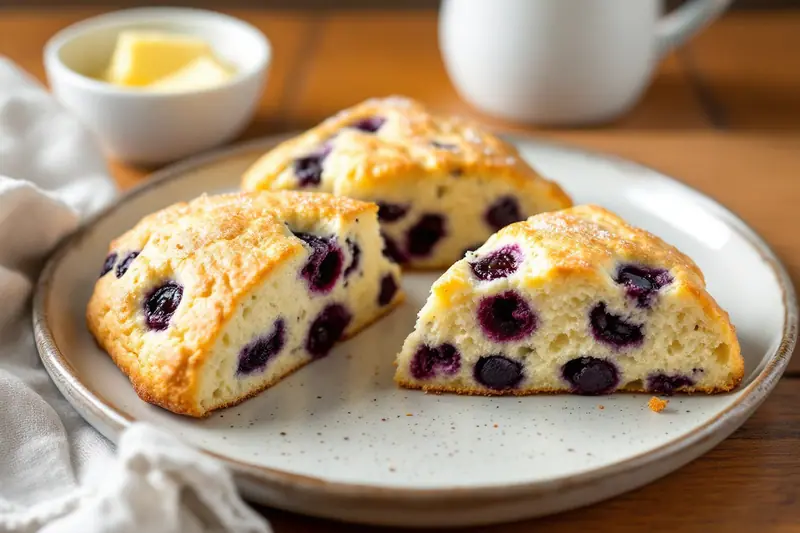
A good scone sits somewhere between a biscuit and a cake. It should be tender enough to break with your fingers, sturdy enough to hold a smear of butter, and only lightly sweet, so that the fruit does the talking. This version gets a small share of stone-ground cornmeal mixed into the flour. You will not taste corn exactly. What you notice is a faint crunch at the edges and a sunnier, nuttier crumb that stands up nicely to blueberries and the grated zest of a whole orange.
I make these as a single round, scored into wedges before it goes into the oven, then break them apart once they are out. Baking them in one piece keeps the sides soft and the centers moist. If you prefer crisp edges all the way around, cut the wedges through and pull them an inch apart on the sheet. Both ways work; it is a question of what you like to bite into.
Why the cornmeal, and how much
Half a cup of cornmeal to a cup and a half of all-purpose flour is about right. Go much past a third of the total and the dough loses its tenderness, because cornmeal brings no gluten and the scones start to crumble when you cut them. Stone-ground meal is coarser than the fine yellow kind in a cardboard canister, and that coarseness is the point. If all you have is fine cornmeal, use it, but expect a smoother, slightly cakier result.
Cornmeal also drinks liquid more slowly than flour. That is why the dough can look a touch shaggy when you first turn it out and then feel right after a minute of gentle kneading. Give it that minute before you reach for extra buttermilk.
Cold butter, cold hands
The flakiness comes from small pieces of butter that stay solid until the oven heat hits them and turns their water into steam. I cut a stick of butter into half-inch cubes and put them back in the refrigerator for 15 minutes while I measure everything else. On a warm May morning I chill the bowl, too.
Work the butter in with a pastry blender or your fingertips until the largest pieces are the size of small peas and the rest looks like coarse meal. A food processor is fine if you pulse it in short bursts, but stop before the mixture turns sandy and uniform. Some visible butter is what you want.
Fresh or frozen blueberries
Both work, and the choice changes your method a little.
- Fresh berries: pick them over, rinse, and dry them very well on a towel. Wet berries add water to the dough and make it sticky. Small wild-type berries are lovely here because they spread evenly.
- Frozen berries: use them straight from the freezer. Do not thaw them, or they will bleed purple streaks through the whole round. Toss them with a tablespoon of the measured flour mixture first, then fold them in at the very end with as few strokes as you can manage.
Frozen berries keep the dough colder, which is a small advantage, but they can add 2 to 4 minutes to the baking time. Check the center rather than the clock.
The egg wash and sugar top
The recipe uses a whole egg plus a yolk in the dough, and the leftover white goes on top. Beat the white with a fork until it is loose and foamy, brush it over the round, then scatter a couple of teaspoons of sugar across it. In the oven the white sets into a thin glossy layer and the sugar crackles. Coarse sugar gives you more crunch; plain granulated is perfectly good.
From the recipe box
Blueberry scones with cornmeal and orange zest
8 wedge scones
- Prep
- 20 min
- Cook
- 22 min
- Rest
- 10 min
- Total
- 52 min
Dough
- 1 1/2 cups190 g all-purpose flour
- 1/2 cup70 g stone-ground yellow cornmeal
- 1/3 cup65 g granulated sugar (use 1/4 cup, 50 g, for a less sweet scone)
- 2 tsp10 ml baking powder
- 1/2 tsp2.5 ml baking soda
- 3/4 tsp4 ml fine salt
- 11 orange, zest finely grated
- 1 stick113 g cold unsalted butter, cut in 1/2-inch cubes
- 1 cup150 g blueberries, fresh and dry or frozen and unthawed
- 1 large1 large egg
- 1 large1 large egg yolk (save the white)
- 1/2 cup120 ml cold buttermilk, plus 1 to 2 tbsp if needed
Topping
- 1 large1 large egg white, beaten until foamy
- 2 tsp10 ml granulated or coarse sugar
Method
- Heat the oven to 425°F (220°C) with a rack in the center and line a baking sheet with parchment or butter it lightly.
- Whisk the flour, cornmeal, sugar, baking powder, baking soda, salt and orange zest together in a large bowl.
- Add the cold butter and cut it in with a pastry blender or your fingertips until the largest pieces are the size of small peas.
- Toss in the blueberries so they are coated with the flour mixture.
- Whisk the egg, yolk and buttermilk together, pour it over the dry mixture all at once and stir with a fork just until no dry flour remains.
- Turn the dough onto a lightly floured counter and knead it gently 4 or 5 times until it holds together, adding a spoonful of buttermilk only if dry crumbs refuse to join.
- Pat the dough into a 9-inch round about 3/4 inch thick, set it on the sheet and score it almost through into 8 wedges with a floured knife.
- Brush the top with the beaten egg white and sprinkle evenly with the sugar.
- Bake 18 to 22 minutes, until the top is deep golden and a skewer pushed into the center comes out clean.
- Let the round rest on the sheet for 10 minutes, then break or cut along the scored lines and serve warm.
Notes from the kitchen
- Unbaked wedges freeze well for up to 1 month; bake them from frozen at 400°F (200°C) for 24 to 28 minutes.
- Baked scones keep a day in a tin; warm them at 325°F (165°C) for 6 to 8 minutes.
About the box below: it links to a shop or service we think fits this page. If you buy or join through it, this journal may be paid a commission, and the price stays the same for you. Our recipes and menus are never written to order.
Making them ahead for a brunch
This is the part that makes scones practical for company. Scones taste best within an hour of baking, but nobody wants to cut butter into flour at seven in the morning with guests due at ten. The answer is to freeze them unbaked.
Mix and shape the dough the day before, or up to a month ahead. Cut the round all the way through into wedges and set them on a parchment-lined sheet so they are not touching. Freeze them uncovered until hard, about 2 hours, then pack them in a zip-top freezer bag with the air pressed out. Leave off the egg white and sugar until baking day.
On the morning itself, set the frozen wedges on a lined sheet 2 inches apart, brush with egg white, sprinkle with sugar and bake at 400°F (200°C), a little cooler than usual so the centers cook before the outsides overbrown. They need 24 to 28 minutes. No thawing.
Scaling for a crowd
One batch makes 8 generous wedges or 12 smaller ones if you pat the round a little thinner and cut it into twelfths. For a brunch buffet I count on 1 1/2 scones per guest when there are other baked things on the table, and closer to 2 when the scones are the main bread.
| Guests | Scones needed | Batches | Baking sheets |
|---|---|---|---|
| 8 | 12 to 16 | 2 | 1 |
| 16 | 24 to 32 | 4 | 2 |
| 24 | 36 to 48 | 5 to 6 | 3, baked in two rounds |
Mix each batch separately rather than doubling in one bowl. A double batch is manageable, but past that the butter warms while you work and the dough gets overmixed trying to bring it all together. Batches can go into the freezer one at a time over a week, which is how I build up a supply before a shower or a graduation brunch.
Variations
Swap the orange for the zest of a lemon and add a teaspoon of chopped fresh thyme to the dry mix. Raspberries work in place of blueberries if they are frozen; fresh ones collapse. For a cranberry version in the fall, use 3/4 cup chopped fresh cranberries and add a tablespoon of extra sugar. The cornmeal suits all of them.
If blueberries are your thing at breakfast, the hotcakes with warm blueberry compote make a good second act on a weekend menu, and the cherry ricotta snack cake is another brunch bake that holds well on a buffet. More baking for gatherings is collected under Cakes and Baking.
Serving
Put the scones out in a cloth-lined basket so they stay warm, with softened butter and a jar of good jam or lemon curd beside them. Clotted cream is lovely if you can find it, but lightly sweetened whipped cream does almost the same job. Pile them no more than two deep, or the bottom layer steams and goes soft. Bake the second sheet about 30 minutes after the first, and the basket stays warm through the whole morning.
Topics: Cakes & Baking

Abigail bakes the cakes, pies and bread for her family's celebrations in western Massachusetts. She writes about layer cakes, crusts, quick breads and baking ahead.