Salmon Mousse: A Retro Molded Spread for Holiday Parties
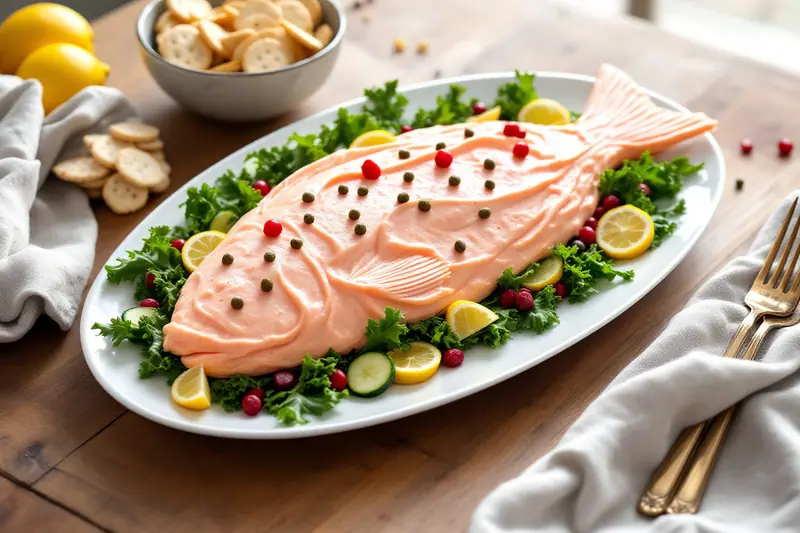
Every December somebody at a party walks up to the buffet, sees a salmon mousse shaped like a fish, and laughs. Then they eat a third of it. The molded mousse is one of those dishes that went out of fashion without ever going out of favor, and it earns its place because it is cheap, quick, made entirely ahead and sturdy on a buffet. It is built on canned red salmon (sockeye), set with a little gelatin and loosened with sour cream and mayonnaise, with lemon, onion, dill and horseradish doing the seasoning. Twenty minutes of work the day before and you have a centerpiece that serves 20.
Why canned sockeye
Fresh salmon makes a fine mousse, but canned red salmon is honestly better here. It has a deeper color than pink salmon, a cleaner flavor, and it comes with its own liquid, which you heat and use to dissolve the gelatin. That liquid carries a lot of flavor that would otherwise go down the drain. Pick out the large pieces of dark skin before you blend; the soft round bones can stay, since they puree away completely.
If you want to use fresh fish, poach about 1 pound of salmon fillet, cool it, and use 1/4 cup of the poaching liquid or a light fish stock in place of the canned liquid.
Getting the set right
Gelatin is the only thing that can go wrong. Sprinkle it over the cold lemon juice and leave it alone for 5 minutes so every granule swells. Then pour on the hot salmon liquid and stir until the mixture is completely clear, with no grains when you rub a drop between your fingers. Undissolved gelatin leaves rubbery specks and a weak set.
This recipe uses enough gelatin to hold a fish shape at cool room temperature for a couple of hours without slumping, but not so much that it turns bouncy. It should slice like a soft pate and spread easily on a cracker. If you plan to serve it in a bowl rather than unmold it, you can cut the gelatin by a third for a softer, creamier spread.
The mold
A 6-cup fish mold is the classic, but any 6-cup ring mold, loaf pan or bowl works. Brush the inside lightly with a neutral oil, then wipe out the excess with a paper towel. You want a film, not a puddle. Have a small ramekin ready, because this recipe makes a little more than most molds hold, and the extra is the cook's snack.
Chill it, covered, at least 6 hours. Overnight is better, and the mousse keeps well for 2 days in the refrigerator before you unmold it.
Unmolding without panic
The easy way: run a thin knife around the top edge. Wring out a kitchen towel in very hot water and press it over the outside of the mold for 30 seconds. Set the serving platter, already lined with kale, upside down on top of the mold, flip the two together and give a firm shake. If nothing happens, repeat the hot towel once or twice and slide the tip of the knife down one side to let in some air. You will hear it let go. Don't dip the whole mold in hot water for long; the outside melts and you lose the detail of the fins.
Unmold it up to 3 hours ahead, then cover it loosely and return the platter to the refrigerator until the guests arrive.
From the recipe box
Molded salmon mousse
About 6 cups, serves 20 as a spread
- Prep
- 20 min
- Cook
- 5 min
- Rest
- 6 hr
- Total
- 6 hr 25 min
Mousse
- 1 large can (about 14 oz)1 large can (about 400 g) red (sockeye) salmon, liquid reserved
- 1/3 cup80 ml fresh lemon juice
- 2 tbsp2 tbsp unflavored powdered gelatin
- 1/41/4 medium onion, roughly chopped
- 1/4 cup15 g fresh dill, chopped
- 1 heaping tbsp20 g prepared horseradish
- 1/4 tsp1.25 ml paprika
- 1 1/2 cups360 ml sour cream
- 1 1/2 cups360 ml mayonnaise
To serve
- 1 bunch1 bunch curly kale, to line the platter
- 11 lemon, thinly sliced
- 1 tbsp15 ml capers, drained
- 1/4 cup25 g fresh cranberries
Method
- Lightly oil a 6-cup mold and wipe out the excess. Set a small ramekin aside for any extra mousse.
- Drain the salmon liquid into a small saucepan. Pick the dark skin from the salmon and discard it.
- Pour the lemon juice into the bowl of a food processor, sprinkle the gelatin over it and let it soften for 5 minutes.
- Bring the salmon liquid to a simmer, pour it over the gelatin and pulse a few times. Scrape down the sides and stir until no grains remain.
- Add the onion and dill and process until fine, then add the salmon and puree until smooth.
- Add the horseradish, paprika, sour cream and mayonnaise and pulse until completely smooth. Taste and add salt or more lemon if needed.
- Pour the mousse into the mold, filling the ramekin with any extra. Cover and refrigerate at least 6 hours, or up to 2 days.
- To unmold, run a knife around the top edge and press a towel wrung out in hot water against the mold for 30 seconds.
- Invert a kale-lined platter over the mold, flip both together and shake firmly; repeat the hot towel if needed.
- Garnish with lemon slices, a caper for the eye and cranberries, and refrigerate until serving.
Notes from the kitchen
- Keep the mousse cold until the doorbell rings and take it off the table after 2 hours at room temperature.
Garnishes that look like you tried
Curly kale is the right base: it frames the fish, hides the edges of the platter and doesn't wilt under the lights. Tuck thin lemon slices down one side, set a single caper where the eye goes, and lay a row of overlapping cucumber or lemon half-moons along the body for scales if you are feeling theatrical. In December, a scatter of fresh cranberries gives the plate the holiday color it wants. Sprigs of dill around the tail are never wrong.
What to serve with it
Plain, sturdy crackers are the classic, since the mousse is rich and seasoned and doesn't need competition. Water crackers, thin rye crisps and slices of toasted baguette all work. For guests who skip bread, thick cucumber rounds are the best vehicle: cool, crunchy and the right size for one swipe. Belgian endive leaves work too.
Put two small spreading knives on the platter, not one. One knife means a line.
Quantities for a party
As one of several hors d'oeuvres, plan on about 1/4 cup of mousse per guest, which is the full recipe for 20 to 24 people. Here is how I plan the rest of the board:
| Guests | Mousse | Crackers or toasts | Cucumber rounds |
|---|---|---|---|
| 12 | 1/2 recipe (3-cup mold) | 60 | 1 English cucumber |
| 24 | 1 recipe | 120 | 2 English cucumbers |
| 48 | 2 recipes, two molds | 240 | 4 English cucumbers |
For 48, set out one mold at the start and keep the second in the refrigerator. Swap it in when the first looks picked over; a half-eaten fish is a sad sight.
Food safety on the buffet
This is a dairy and fish spread, so it lives by the 2-hour rule. Keep it at 40°F (4°C) or below until it goes out, and don't leave it at room temperature longer than 2 hours in total. For a long party, nest the platter on a tray of crushed ice, or serve it in two shifts as above. Leftovers that sat out for the whole evening go in the trash, not back in the fridge.
Questions from hosts
Can I freeze it?
No. Sour cream and mayonnaise separate when frozen, and the texture turns grainy.
Can I make it lighter?
You can swap half the mayonnaise for more sour cream or for thick Greek yogurt. The set will be slightly softer, so keep it well chilled.
What else goes on the table?
It sits happily next to a bowl of creamy curry dip with crudites, which gives the vegetable eaters something of their own. More ideas for a holiday spread are under Party Food and Hors d'Oeuvres, and full party plans are in the sample menus.
Topics: Party Food & Hors d'Oeuvres

Tomoko grew up in a family that entertained constantly, in Connecticut and later in Boston. She writes about hors d'oeuvres, party platters and the kitchen habits that keep food safe for a crowd.