Vermont Apple Pie with a Butter and Shortening Crust
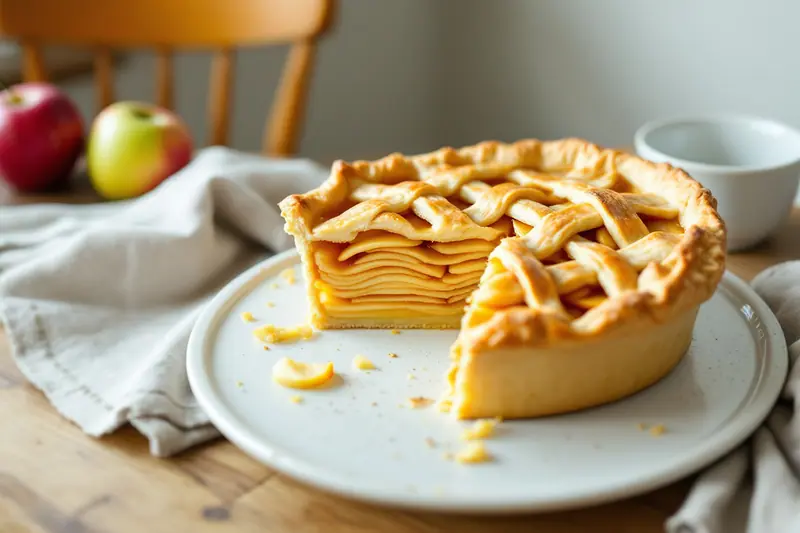
Apple pie is the one dessert where the shopping matters more than the baking. By early October the orchards around here have a dozen varieties at once, in bins with hand-lettered cards, and the pie you make depends on which three or four you carry home. This version is a straightforward double-crust pie: a crust made with both butter and vegetable shortening, three pounds of firm apples sliced thin, dark brown sugar, lemon and a full set of warm spices, and a little dusting of flour and sugar on the bottom crust to keep it from going soggy. It bakes on a preheated sheet pan, hot at first and then gentler, until the juice bubbles thickly through the vents.
Choosing the apples
The goal is slices that soften completely but keep their shape, with enough acid to stand up to the sugar. A single variety gives a flat pie. Two or three together give layers of flavor and texture.
| Apple type | Examples | What it brings |
|---|---|---|
| Firm and tart | Granny Smith, Northern Spy, Rhode Island Greening | Structure and sharpness; holds its shape |
| Firm and sweet-tart | Pink Lady, Honeycrisp, Jonagold | Juice and a balanced flavor |
| Aromatic, softer | McIntosh, Cortland | Perfume and a saucy layer between slices |
My usual mix is half firm-tart apples, a third sweet-tart, and one or two softer apples for fragrance. If you only find one kind at the store, choose Granny Smith and Pink Lady together and you will not be disappointed. At an orchard, ask which apples are being picked that week rather than which are in storage; a freshly picked Northern Spy is worth the detour. Avoid apples that are mealy when you bite them. Mealy raw means mush in the pie.
Three pounds of whole apples, about seven medium, gives roughly eight cups of slices, which fills a 9-inch deep pie plate with a good dome.
Why butter and shortening
All-butter crust tastes best but is fussy to roll and can shrink. Shortening makes a crust that is tender, flaky and very forgiving, though bland on its own. Using both, about three parts butter to two parts shortening by volume, gives you most of the flavor and most of the ease. Everything must be cold. I cut the butter into cubes and put both fats in the freezer for 15 minutes before I start.
In a food processor, pulse the fats into the flour until the largest pieces are the size of small peas. Add ice water a tablespoon at a time and stop as soon as a pinch of dough holds together when squeezed. On a humid day you may need only four tablespoons; on a dry, cold one, closer to seven. Turn it out, press it into two discs, wrap them and chill overnight. A rested dough rolls without springing back and shrinks far less in the oven.
The bottom crust problem
A juicy filling sitting on raw pastry is the reason for most pale, damp bottom crusts. Three things fix it. First, a tablespoon or so each of flour and sugar spread over the bottom crust before the apples go in absorbs the first juices and turns into a thin syrup layer instead of soaking the pastry. Second, the pie bakes on a sheet pan that has been heating in the oven, so the bottom gets a blast of heat right away. Third, a glass or metal pie plate conducts heat better than thick ceramic. If you use glass you can lift it and look at the bottom: it should be golden brown, not pale.
Spicing
Cinnamon leads, with smaller amounts of allspice, ginger, nutmeg and cloves behind it. Cloves are strong; a quarter teaspoon is plenty for three pounds of apples. Taste a slice of apple tossed with the sugar and spices before you fill the crust. It should taste a little too sweet and a little too spiced raw, because the apples release a lot of juice in the oven.
From the recipe box
Vermont apple pie
One 9-inch double-crust pie, serves 8
- Prep
- 50 min
- Cook
- 1 hr 15 min
- Rest
- 3 hr
- Total
- 5 hr 5 min
Crust
- 2 1/2 cups313 g all-purpose flour, plus more for rolling
- 1 tsp6 g fine salt
- 1 tbsp12 g sugar
- 10 tbsp141 g cold unsalted butter, cubed
- 6 tbsp75 g cold vegetable shortening, in pieces
- 5 to 7 tbsp75 to 105 ml ice water
Filling
- 3 lb1.35 kg mixed firm apples, peeled, cored and sliced 1/4 inch thick
- 2 tbsp30 ml fresh lemon juice
- 1/2 cup105 g packed dark brown sugar
- 2 tbsp16 g all-purpose flour
- 1 tsp2 g ground cinnamon
- 1/2 tsp1 g ground allspice
- 1/4 tsp0.5 g each ground ginger, nutmeg and cloves
- 1 1/2 tbsp12 g each flour and sugar, mixed, for the bottom crust
- 1 tbsp14 g unsalted butter, in small dots
Method
- Pulse the flour, salt and sugar in a food processor, add the butter and shortening and pulse until the largest pieces are pea-sized.
- Add ice water a tablespoon at a time, pulsing, just until a pinch of dough holds together. Divide in two, press into discs, wrap and chill at least 2 hours or overnight.
- Toss the apple slices with the lemon juice, then with the brown sugar, 2 tablespoons flour and the spices.
- Set a rack in the lower third of the oven, put a rimmed sheet pan on it and heat the oven to 375°F (190°C).
- Roll one disc to a 12-inch round, fit it into a 9-inch deep pie plate and spread the flour and sugar mixture over the bottom.
- Pile in the apples and their juices, mounding them in the center, and dot with the butter.
- Roll the second disc, lay it over the filling, trim to a 1/2-inch overhang, tuck the edges under and crimp. Cut four or five vents in the top.
- Set the pie on the hot sheet pan and bake 20 minutes at 375°F (190°C).
- Lower the oven to 350°F (175°C) and bake 45 to 55 minutes more, until the crust is deep golden and thick juice bubbles slowly through the vents. Shield the edge with foil if it browns too fast.
- Cool on a rack at least 3 hours so the juices thicken before slicing.
Notes from the kitchen
- The wrapped dough discs freeze for a month; thaw overnight in the refrigerator.
- A baked pie keeps at room temperature, loosely covered, for 2 days.
Variations
Replace a quarter cup of the brown sugar with pure maple syrup and add a tablespoon of extra flour to the filling to handle the liquid. Swap a cup of apples for fresh cranberries in November for a sharper, pinker pie. A lattice top lets more steam escape and gives a slightly thicker filling. For a cheddar crust, the old Vermont habit, work half a cup of finely grated sharp cheddar into the flour before the fats.
Making ahead
Make the dough up to three days ahead in the refrigerator. You can assemble the whole pie, wrap it well and freeze it unbaked for up to a month; bake it straight from the freezer on the hot sheet pan, adding about 20 minutes to the time at the lower temperature. A pie baked the morning of a dinner is at its best that evening, once it has cooled completely and the filling has set.
About the box below: it links to a shop or service we think fits this page. If you buy or join through it, this journal may be paid a commission, and the price stays the same for you. Our recipes and menus are never written to order.
Scaling for a crowd
A 9-inch pie cuts into 8 slices for a dessert course, or 10 thinner ones on a buffet where people take a little of several things. For an October party of 30 with two other desserts, plan four pies. Bake no more than two at a time in a home oven, each on its own sheet pan on a separate rack, and switch the racks halfway through. Three pounds of apples per pie means a full half-bushel bag will cover about six pies with a few apples to spare for eating.
Serving
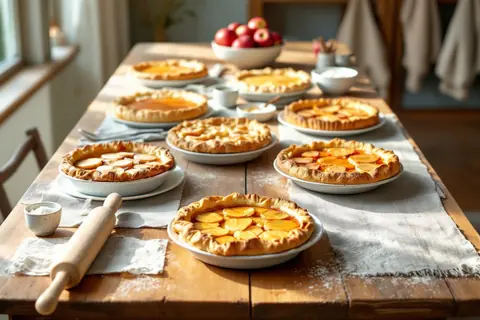
Serve the pie barely warm or at room temperature, with vanilla ice cream, softly whipped cream or a thin slice of aged cheddar. If you are setting out a full fall dessert table, it pairs well with a maple pecan pie and something cakey like the cherry ricotta cake made with frozen fruit. More orchard and harvest cooking is under The Seasonal Table.
Cut the first slice with a sharp knife and lift it with a pie server held flat. If the apples stand up in layers and a little syrup runs into the gap, the pie is right.
Topics: Cakes & Baking | The Seasonal Table

Abigail bakes the cakes, pies and bread for her family's celebrations in western Massachusetts. She writes about layer cakes, crusts, quick breads and baking ahead.