Celebration Cakes: Choosing Styles, Flavors and Servings
A celebration cake has two jobs, and they pull in different directions. It has to look like the center of the party for the ten minutes when everyone gathers around it, and then it has to be cut, plated and eaten by a crowd that has already had dinner. The best cakes I have baked for weddings and big birthdays were the ones planned around both moments: a style that suits the room, a flavor that people actually finish, and a size worked out from the guest list rather than from a picture.
This guide walks through those choices in the order I make them. It is written for hosts who are ordering from a baker, and for the brave ones baking their own.
Start with the style
The style of the cake decides how much work it is, how well it travels and how it slices. Here is how the common ones compare.
| Style | What it is | Best for | Watch out for |
|---|---|---|---|
| Layer cake | Two to four round layers, filled and frosted | Birthdays, anniversaries, parties up to about 30 | Tall four-layer cakes need a dowel or two to stay level |
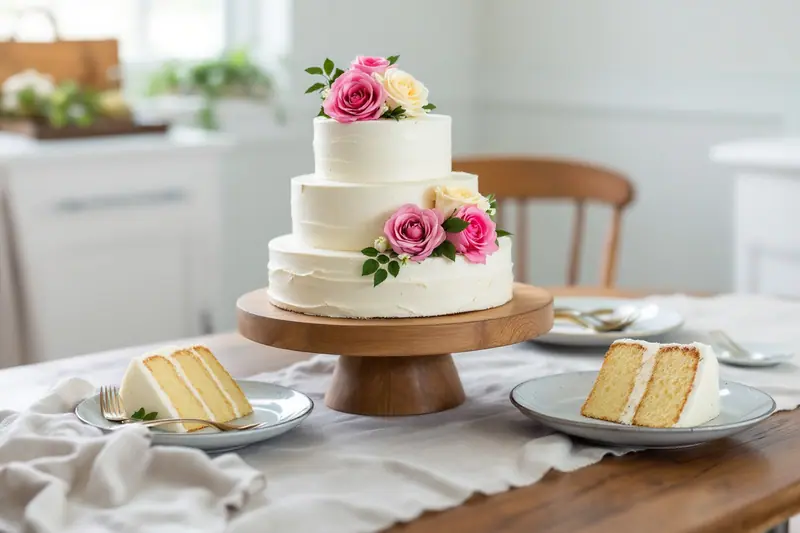
| Tiered cake | Stacked layer cakes on boards, held with dowels | Weddings, milestone anniversaries | Needs internal supports and careful transport |
| Sheet cake | One large rectangle, single or double layer | Big crowds, office parties, a backup kitchen cake | Looks plain unless decorated with care |
| Naked cake | Layers with filling but only a thin scrape of frosting on the sides | Summer and barn weddings, fruit fillings | Exposed sides dry out; assemble the same day |
| Buttercream decorated | Smooth or textured buttercream, piped borders | Almost anything | Soft in a hot tent; keep it shaded |
Decoration sits on top of these choices. Fresh flowers are the simplest way to dress a plain cake: a cascade of roses down one side of a tiered cake, or a small cluster on top of a layer cake. Use flowers grown without sprays, wrap the stems in floral tape and push them into a short straw so no stem touches the cake. Remove them before cutting.
A birch-bark finish is a favorite for fall and country weddings. The cake is covered in white buttercream, then streaked with a thin chocolate or gray buttercream using an offset spatula, and the dark knots and lines are piped or painted on afterward. It looks like a slice of a white birch log and it forgives small mistakes, which matters when you are decorating at midnight. Some couples carve or pipe their initials into a heart on the "bark."
Choosing flavors and fillings
Most guests eat cake after a full meal, so a bright filling does more work than a rich one. Pairings I come back to:
- Lemon cake with raspberry filling. Tart, pretty when cut, and liked by nearly everyone. A thin layer of raspberry jam under lemon buttercream is enough.
- Chocolate with raspberry. A dark chocolate layer cake with raspberry preserves and a chocolate or vanilla buttercream. The fruit keeps the chocolate from feeling heavy.
- Carrot cake. Moist, keeps well, and the cream cheese frosting holds up to a day of display in a cool room. Good for anniversaries and birthdays where the cake is the whole dessert.
- Coconut cake with lime curd. A white or coconut cake filled with lime curd and finished with coconut buttercream and a scatter of berries. It tastes like summer.
- Classic white or yellow cake with vanilla buttercream. Never the wrong answer, especially for a tier you want everyone to try.
For a tiered cake you can mix flavors by tier: chocolate on the bottom, lemon in the middle, white on top. Tell whoever cuts the cake which tier is which. For a smaller party, the just desserts guide has ideas for building a sweets table around one cake.
Fillings set the practical limits. Whipped cream and fresh fruit fillings need refrigeration and do not belong in a cake that sits out for hours. Jams, curds stabilized with butter, ganache and buttercream fillings are safer for display. Anything with cream cheese, curd or custard should go back in the refrigerator if the room is warm and the cake will be out longer than two hours.
How many servings per size
Wedding servings are traditionally smaller than party servings: about 1 by 2 inches by the height of the cake, against roughly 2 by 2 inches at a birthday. These are the counts I plan from for round cakes about 4 inches tall.
| Round size | Wedding slices | Party slices |
|---|---|---|
| 6 inch | 12 | 8 |
| 8 inch | 24 | 14 |
| 10 inch | 38 | 24 |
| 12 inch | 56 | 34 |
| 14 inch | 78 | 46 |
A half sheet (about 12 by 16 inches) gives around 48 party slices or close to 90 wedding slices if cut small.
A worked example: a wedding for 120 guests. A three-tier cake of 6, 10 and 14 inches gives 12 + 38 + 78 = 128 wedding slices, with a little margin for the slices that get dropped or cut too big. If the couple wants to save the top tier, subtract its 12 slices and you are at 116, which is too tight. In that case I add a plain half sheet of the same flavor in the kitchen, iced but not decorated, and cut from that first.
Ordering from a baker or baking your own
Ordering is the right call for most weddings and for any cake taller than two tiers. When you talk to a baker, bring the guest count, the date and the venue, a photo or two of styles you like, and the flavors you want to taste. Ask how the cake will be delivered, whether they set it up, what supports they use inside the tiers, and when they need final numbers. Ask also what they need from you at the venue: a sturdy table, a cool spot, a cake knife.
Baking your own works well for layer cakes, sheet cakes and naked cakes up to about two tiers, if you plan the week. My schedule for a Saturday party:
- Monday: bake the layers, cool, wrap twice in plastic and freeze.
- Wednesday: make the buttercream and the curd or jam filling; refrigerate.
- Thursday evening: thaw the layers in the refrigerator, still wrapped.
- Friday: level, fill and crumb coat; chill; frost and decorate. Insert dowels if stacking.
- Saturday: add fresh flowers or fruit, and move the cake.
Frozen layers are easier to level and fill, and the cake tastes the same. For a snack-cake option on a casual day, the cherry ricotta cake bakes in one pan and travels without fuss.
Transport and display
Cakes are lost in cars, not in kitchens. Move tiered cakes in separate tiers and stack them at the venue if you can. Chill the cake well first; cold buttercream is firm and forgives a bump. Carry it flat on the floor of the car or on a level surface with a nonslip mat under the box, never on a lap or a sloped seat. Keep the car cool, drive like you are carrying soup, and bring a small kit: spare buttercream in a piping bag, an offset spatula, a few extra flowers and paper towels.
At the venue, set the cake out of the sun and away from the heat of the buffet. A round table of its own, covered in a plain cloth, shows it off better than a corner of the dessert table. The fall wedding dinner for 85 shows how a cake fits into the timeline of a full menu.
Plan the cutting too. One person with a long thin knife, a tall glass of hot water and a clean towel can cut about a hundred wedding slices in twenty minutes. Score the top tier first, cut each tier in rows rather than wedges, and have plates and forks lined up before the knife goes in.
Topics: Cakes & Baking | Menus & Planning

Abigail bakes the cakes, pies and bread for her family's celebrations in western Massachusetts. She writes about layer cakes, crusts, quick breads and baking ahead.