Roasted Red Snapper, Mediterranean Style, with Olives and Lemon
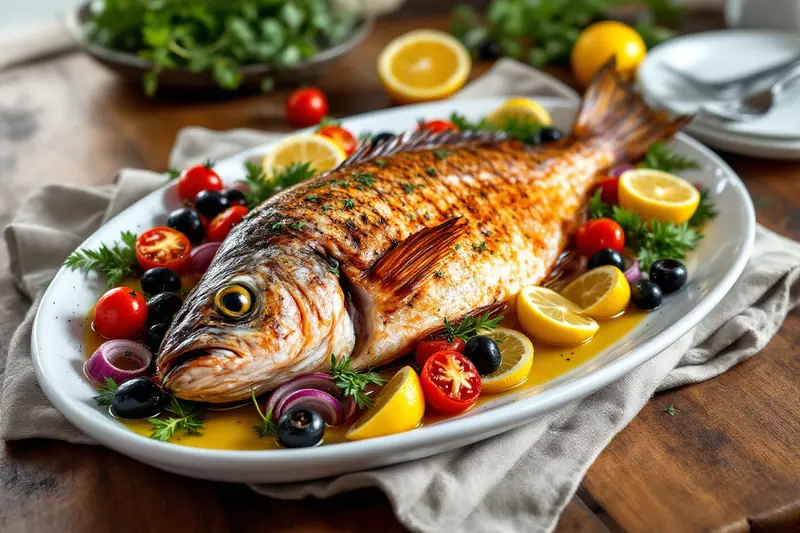
A whole fish on a platter does more for a dinner table than any amount of garnish, and it is less work than a roast chicken. Red snapper is ideal for this: the skin is a handsome rose color that survives the oven, the flesh is white, sweet and firm, and a fish of about two pounds serves two hungry people or three polite ones. Here it is scored, stuffed with garlic slivers and herbs, rubbed with a little cumin, coriander and sumac, and roasted at high heat on a bed of tomatoes, onions, peppers and olives. Lemon goes on at the end. The pan juices are the sauce.
Snapper is not a local fish in New England, so when a good one shows up at the fish counter in January, buy it and change your dinner plans around it.
Checking a whole fish
A whole fish is easier to judge than a fillet, which is one more reason to buy it that way. Look for these signs, in roughly this order:
- Eyes: clear, bright and bulging. Cloudy, sunken or gray eyes mean an old fish.
- Gills: lift the gill cover. They should be bright red and clean, not brown or slimy.
- Smell: like cold seawater or cucumber. Any sour or strong fishy smell is a no.
- Flesh: press the thick part of the side. It should spring back and leave no dent.
- Skin: shiny and wet looking, with scales tight to the body.
Ask the fishmonger to scale and gut it and to trim the fins, which are sharp. Leave the head and tail on. They hold the shape of the fish in the oven, and the cheek meat is the best bite on the platter.
Scoring and seasoning
Pat the fish completely dry, inside and out. Wet skin steams and sticks. Then make three or four diagonal cuts on each side, down to the bone but not through it, about an inch and a half apart. The cuts let heat reach the thick part at the same rate as the thin tail, and they give you pockets for garlic and herbs.
Slice the garlic into thin slivers rather than mincing it. Slivers tucked into the cuts roast sweet and soft; minced garlic on the surface of a hot pan burns before the fish is done. Push a sliver or two and a pinch of chopped oregano or thyme into each cut, then rub the fish with the spice mixture and olive oil. Put lemon slices, a few herb sprigs and some onion inside the cavity.
The spice rub is optional, but sumac in particular is worth finding. It is a dark red powder, sour and lemony, sold wherever Middle Eastern spices are, and it gives the skin color and a bright edge.
Doneness
At 425°F (220°C), a 2-pound snapper takes 25 to 30 minutes. The general rule of 10 minutes per inch of thickness, measured at the thickest point behind the head, is a good starting estimate. Three checks are better than any timer:
- The flesh in the deepest score has turned from translucent to opaque white all the way to the bone.
- The dorsal fin, if it was left on, pulls out with a gentle tug.
- An instant-read thermometer pushed into the thickest part, not touching bone, reads 140°F (60°C). It will rise to 145°F (63°C) as it rests for five minutes.
If the fish needs more time but the vegetables are getting dark, tent the pan loosely with foil.
From the recipe box
Roasted red snapper, Mediterranean style
One whole fish, serves 2 to 3
- Prep
- 20 min
- Cook
- 30 min
- Rest
- 5 min
- Total
- 55 min
Fish
- 1 (about 2 lb)1 (about 900 g) whole red snapper, scaled, gutted and fins trimmed
- 66 garlic cloves, cut into thin slivers
- 2 tbsp6 g chopped fresh oregano or thyme, plus a few whole sprigs
- 11 lemon, half thinly sliced, half cut into wedges
- 1 tsp2 g ground cumin
- 1 tsp2 g ground coriander
- 1/2 tsp1 g sumac
- 1 tsp6 g kosher salt, plus more for the vegetables
- 1/2 tsp1 g black pepper
Pan
- 1 pint300 g cherry tomatoes, or 2 ripe tomatoes in thick slices
- 11 small red onion, sliced into rounds
- 11 yellow or orange bell pepper, sliced
- 1/2 cup75 g black olives, such as Kalamata, pitted or not
- 1/4 cup60 ml extra virgin olive oil, divided
Method
- Heat the oven to 425°F (220°C) with a rack in the center and brush a large baking dish or rimmed sheet pan with olive oil.
- Pat the fish dry inside and out and cut three or four diagonal slashes to the bone on each side.
- Mix the cumin, coriander, sumac, salt and pepper in a small bowl.
- Push garlic slivers and a pinch of chopped herbs into each slash, then rub both sides of the fish with 1 tablespoon oil and three quarters of the spice mix.
- Fill the cavity with the lemon slices, herb sprigs and a few onion rings, and lay the fish in the center of the pan.
- Scatter the tomatoes, remaining onion, pepper and olives around it, sprinkle with the rest of the spice mix and a little salt, and drizzle everything with the remaining oil.
- Roast 25 to 30 minutes, until the flesh in the deepest cut is opaque to the bone and a thermometer in the thickest part reads 140°F (60°C).
- Rest the fish 5 minutes in the pan, then squeeze a lemon wedge over it and carry the whole pan or platter to the table with the remaining wedges.
Notes from the kitchen
- Two 1 1/4-pound fish cook faster than one large one, in about 20 minutes, and are easier to serve.
- Leftover fish, picked off the bone, makes a good next-day salad with the roasted tomatoes and olives.
Filleting at the table
This is the part people worry about, and it takes about two minutes. Use a dinner knife and a large spoon or fish server.
Run the knife along the backbone from head to tail, then along the belly line. Cut down behind the head and in front of the tail. Now slide the server under the top fillet and lift it off the skeleton in two or three pieces onto plates. With the top fillet gone, lift the tail and pull upward and toward the head: the whole spine and rib cage come away in one piece. Set it aside on a side plate. The bottom fillet is now lying on the platter, boneless, and you can portion it straight from there. Spoon pan juices and vegetables over each serving. Point out the cheeks to anyone who seems adventurous.
Scaling to a platter of several fish
For a dinner party of eight, two-pound fish are awkward: each one needs its own deep pan. Four or five small snappers of 1 1/4 to 1 1/2 pounds each fit on two sheet pans and roast in about 20 minutes. Allow roughly 3/4 pound of whole fish per person, which yields about 6 ounces of cooked fish on the plate.
| Guests | Whole fish (1 1/4 to 1 1/2 lb each) | Sheet pans | Roasting time at 425°F (220°C) |
|---|---|---|---|
| 4 | 2 to 3 | 1 | 20 to 25 minutes |
| 8 | 4 to 5 | 2 | 20 to 25 minutes, rotate pans halfway |
| 12 | 7 | 3 (in two batches) | 20 to 25 minutes per batch |
Score, stuff and rub the fish up to three hours ahead and keep them covered on the pans in the refrigerator. Take them out 20 minutes before roasting.
What to serve with it
Plain white rice or a pilaf soaks up the juices. Crusty bread does the same job with less effort. A bitter winter salad like the greens with pears, Asiago and cashews suits the oily, briny pan. If the dinner starts with a fish course such as home-cured gravlax, keep the portions small and let the snapper be the main event. More whole roasts and dinner party mains are under Main Dishes.
The last job is the skeleton. Put it on a plate in the kitchen, not back on the table, and nobody will remember that the fish was ever whole.
Topics: Main Dishes

Wes grew up on the New Hampshire side of the river and does most of his cooking over a grill or in a big roasting pan. He writes about main dishes, fish and feeding a crowd outdoors.