Outdoor October Wedding Dinner: Tent Menu, Stations and Quantities
An October wedding outdoors is a lovely gamble. The leaves are at their best, the light is gold for the ceremony, and by the time the toasts start it can be 45°F (7°C) in the tent and dark as a cellar. Planning the food for that evening means planning for two different parties: a mild late afternoon with cheese and passed bites, then a cold night where everything on the dinner stations has to stay hot and everyone wants something warm in their hands.
This menu is written for 100 guests, which is a common size for a backyard or farm wedding. The quantities scale cleanly up or down; I've put the per-guest figures in the table so you can do your own math.
The menu
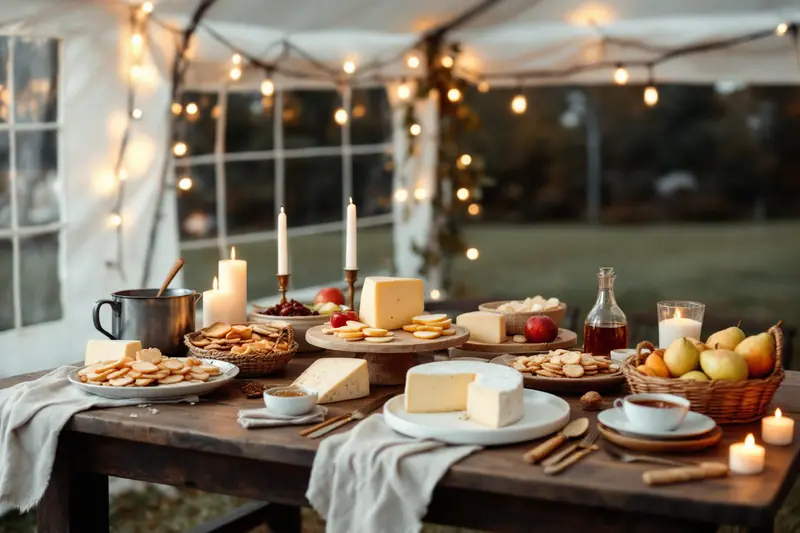
Two cheese stations
- Aged cheddar, a soft bloomy cheese, a blue and a firm sheep's milk cheese
- Seasonal fruit: apples, pears, grapes
- Two chutneys (apple and cranberry) and honey
- Assorted crackers and sliced baguette
Passed hors d'oeuvres
- Chicken satay with peanut sauce
- Mushrooms stuffed with sausage and Gruyère
- Crostini with fig jam, caramelized onions and Gorgonzola
- Ratatouille in small corn cups
- Medjool dates stuffed with goat cheese and pecans, wrapped in bacon
- Fresh herb deviled eggs
Dinner stations
- Salad station: mixed greens with dried cranberries, toasted walnuts and goat cheese; kale salad; cherry tomato and mozzarella salad
- Grill station: coffee-rubbed tri-tip and barbecue chicken
- Vegetable station: roasted squash, beets, carrots with caraway, Brussels sprouts, grilled potatoes
- A chili and dip station for the hungry ones: black bean dip, meat chili, guacamole, salsa, corn chips
Dessert and late night
- Carrot cake with cream cheese frosting as the wedding cake
- Coffee, tea and hot cider
- Sliders for the dancers, about half the guest count, two hours after dinner
Why two cheese stations
One cheese table for 100 people becomes a traffic jam with a bride stuck in the middle of it. Two stations, at opposite ends of the tent or one inside and one on the lawn, spread the crowd and give the passers a clear path. Set each one identically so nobody wonders whether they're missing the good one. Cheese also behaves well outdoors in October: cool air keeps it from sweating, and it can sit out for the full cocktail hour.
Quantities for 100
| Item | Per guest | For 100 |
|---|---|---|
| Cheese (all kinds) | 2 oz | 12 to 13 lb, split between stations |
| Fruit | 3 oz | 20 lb mixed |
| Crackers and baguette | 6 pieces | 600 pieces |
| Passed bites, 6 kinds | 7 pieces | 700 (about 120 of each) |
| Deviled eggs | 1 1/2 halves | 75 eggs (150 halves) |
| Tri-tip, raw | 5 oz | 32 lb (about 13 roasts) |
| Chicken, bone-in, raw | 7 oz | 44 lb |
| Mixed green salad | 1 1/2 oz greens | 9 lb greens |
| Roasted vegetables, raw | 5 oz total | 32 lb across all kinds |
| Wedding cake | 1 slice | 3-tier cake for 110 |
| Coffee | 1 cup | 6 gallons, plus 4 gallons cider |
| Late sliders | 1 1/2 | 75 for 50 eaters |
Passed hors d'oeuvres before a full dinner run about 6 to 8 pieces per guest over an hour. In cold weather people eat more, not less, so I plan at the high end. The two proteins are figured so that every guest can take some of both; about a quarter of the raw weight cooks away from the beef.
Cold-weather logistics
Keeping food hot
Chafing dishes are the backbone of a tented dinner, and they behave differently in cold air. A pan of roasted vegetables that would hold for two hours in a warm dining room loses its heat in forty minutes on a windy October night. What helps:
- Use chafers with lids, and keep the lids on between guests.
- Buy the longer-burning wick fuel (about six hours) rather than the gel cans that run two. Bring twice as many as you think.
- Set stations on the side of the tent away from the open entrance, and close the sidewalls on the windward side.
- Put a probe thermometer in each hot pan. Hot food should stay at 140°F (60°C) or above. Anything that drops below and has been out two hours goes.
- Refill with small pans from the kitchen instead of topping off one big pan. A fresh, hot half pan beats a lukewarm full one.
- Warm the dinner plates. A cold plate takes the heat out of food in the time it takes to walk back to the table.
Early dark
In mid-October in New England the sun is down not long after six, and twilight is short. Plan the tent lighting with the food in mind: string lights over each station, battery lanterns on the tables (open flames near chafer fuel and linens make me nervous), and a headlamp or clip light for whoever is working the grill. Serve dinner while there is still some light if you can; guests find a buffet much more easily before full dark.
Warm drinks
Set a hot cider urn by the entrance to the tent and a coffee station near dessert. Cider with a few cinnamon sticks and orange slices floating in it costs little and is the single most appreciated thing at a cold wedding. For 100 guests, two 3-gallon urns of coffee and one of cider carry the night, with a refill of each started after dinner.
Passing hors d'oeuvres outside
Six kinds is plenty. Pass them in two waves: three cold bites (deviled eggs, crostini, ratatouille cups) for the first twenty minutes, then the three hot ones (satay, mushrooms, dates). Cold bites hold on trays; hot ones should go out from the kitchen in small batches of 20 to 25 pieces so they are still warm when they reach the far corner of the lawn. One passer per 25 to 30 guests keeps trays moving.
The dates and mushrooms both reheat well. Assemble them the day before, refrigerate on sheet pans, and bake in rounds during the cocktail hour. The deviled eggs should stay cold: fill them no more than a couple of hours before serving and keep the trays in the refrigerator between rounds.
For more small bites to swap in, the party food shelf has plenty.
Timeline for the day
- Two days before: Make the chutneys, peanut sauce, chili and black bean dip. Hard-cook the eggs.
- The day before: Stuff and wrap the dates, stuff the mushrooms, make the ratatouille, rub the tri-tips, marinate the chicken, wash greens, cut vegetables for roasting.
- Morning of: Roast the vegetables, which will be reheated in the chafers. Bake the corn cups. Fill the eggs at the last moment.
- 3:30 p.m.: Ceremony. Cheese stations set before guests leave their seats.
- 4:15: Passed bites, first wave, then second.
- 5:00: Grill the tri-tip to 125°F (52°C) for medium rare, and the chicken to 165°F (74°C).
- 5:30: Rest and slice the beef; dinner stations open while there is still light.
- 7:00: Cake and coffee.
- 9:00: Sliders.
If you are deciding whether to hire a full crew for a wedding this size, the guide to full-service catering walks through what you get, and the fall wedding dinner for 85 is a good comparison for a seated version.
Swaps and dietary notes
- Vegetarians are well covered by the cheese stations, the salads, the vegetable station and the black bean dip. Add a pan of roasted portobellos or a vegetable chili on the grill station so they have a main.
- Label the satay sauce and the walnut salad for nuts.
- The dates and mushrooms both contain pork; mark the trays so passers can answer.
- For a gluten-free guest, the deviled eggs, satay, dates and every dinner station except the crackers are fine as written.
The bacon-wrapped dates
These are the first tray to come back empty at every wedding I've cooked for. Make them a day ahead and bake them in batches as the hot wave starts.
From the recipe box
Bacon-wrapped dates with goat cheese and pecans
48 pieces
- Prep
- 45 min
- Cook
- 18 min
- Rest
- 5 min
- Total
- 1 hr 8 min
Dates
- 4848 large Medjool dates, pitted
- 4 oz113 g fresh goat cheese, softened
- 4 oz113 g cream cheese, softened
- 4848 toasted pecan halves
- 1 1/2 lb680 g thin-sliced bacon (about 24 slices), cut in half crosswise
- 1 pinch1 pinch black pepper
Method
- Heat the oven to 425°F (220°C) and line two rimmed sheet pans with foil and a rack.
- Beat the goat cheese and cream cheese together with the pepper until smooth.
- Slit each date along one side and fill it with about 1 teaspoon of the cheese mixture.
- Press a pecan half into the cheese and close the date around it.
- Wrap each date in a half slice of bacon, seam side down, and set them on the racks an inch apart.
- Bake 15 to 18 minutes, until the bacon is browned and crisp at the edges.
- Rest 5 minutes so the cheese sets, then move to trays with cocktail picks.
Notes from the kitchen
- Wrap the dates up to a day ahead and refrigerate them on the pans; add 2 or 3 minutes to the baking time.
- For 100 guests make 120 pieces: two and a half batches, baked in three rounds during the cocktail hour.
When the last tray of dates comes out of the oven, turn it down to 200°F (95°C) and slide in the stacks of dinner plates. By the time the stations open, the tent is cold and those warm plates are wanted.
Topics: Menus & Planning | The Seasonal Table

Lorna has cooked for church suppers, family reunions and a good many backyard weddings in the Connecticut River valley. She writes about menus, quantities and keeping a party on schedule.