No-Bake Chocolate Custard for Two That Sets Like a Mousse
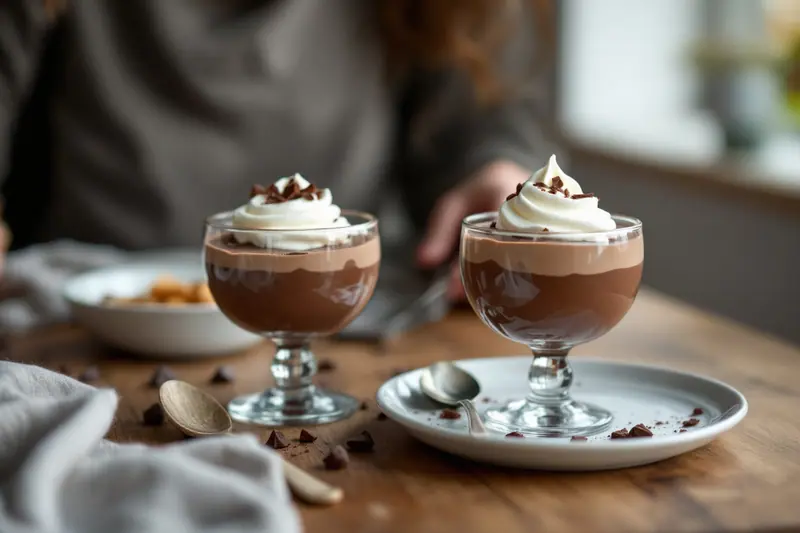
Some desserts are worth making for exactly two people, and this is the one I reach for in early spring, when the evenings are still cold enough for chocolate and nobody wants to turn on the oven for a whole cake. It is a small stovetop custard: a little milk and sugar, one egg yolk, good bittersweet chocolate and a spoonful of butter. It takes about 20 minutes of real work. Eaten after a short chill it is a soft pudding; left in the refrigerator for an hour or two it firms into something very close to a dense chocolate mousse, without any folding or whipping of egg whites.
The quantities are tiny, which makes the technique matter more than usual. One yolk in a small saucepan cooks faster than you expect, and a few degrees decide whether you get silk or scrambled egg. Here is how I keep it on the right side of that line, then how to scale it for a dinner party in ramekins.
The chocolate decides the dessert
With so few ingredients, the chocolate is the dessert. Use a bittersweet bar in the 60 to 70 percent cacao range, chopped fine with a serrated knife so it melts the moment it hits the hot custard. Chocolate chips are made to hold their shape in cookies; they melt thicker and can leave the custard slightly grainy. Above 72 percent the custard sets very firm and tastes almost bitter, which some people love, but add an extra teaspoon of sugar if you go that way.
Weigh it if you can. Three ounces (85 g) of chocolate to a third of a cup of milk gives a set that holds a spoon upright after two hours. More chocolate and it turns fudgy; less and it stays a pudding.
Cooking the yolk to 160°F (71°C)
This is the step that makes the dessert safe as well as smooth. Egg yolks need to reach 160°F (71°C) to be considered fully cooked by general food safety guidance, and conveniently that is also about where they thicken a custard without curdling. Curdling starts somewhere above 180°F (82°C), so you have a comfortable window if you pay attention.
The method is a classic tempering. Heat the milk and sugar until steaming, whisk a little of the hot milk into the yolk to warm it gently, then pour it all back into the pan and cook over low heat, whisking constantly. An instant-read thermometer takes the guessing out: tip the pan so the custard pools on one side and read it there, since a shallow layer will mislead the probe. Without a thermometer, watch for the custard to coat the back of a spoon so that a finger drawn through it leaves a clean line that does not flood back. In a small pan that happens in 2 to 3 minutes.
Take it off the heat the moment it gets there. The chocolate and butter go in off the heat, which cools the custard quickly and stops any further cooking.
Butter, salt and the finish
Soft butter whisked in at the end gives the set custard a glossy surface and a rounder feel on the tongue. A real pinch of salt sharpens the chocolate more than any extra sugar would. For the topping I whip a half cup of heavy cream with a teaspoon or two of sugar and a pinch of cinnamon, which adds a faint warmth without announcing itself.
From the recipe box
No-bake chocolate custard for two
2 small but rich servings
- Prep
- 10 min
- Cook
- 8 min
- Rest
- 2 hr
- Total
- 2 hr 18 min
Custard
- 1/3 cup80 ml whole milk
- 2 tbsp25 g granulated sugar
- 1 large1 large egg yolk, at room temperature
- 3 oz85 g bittersweet chocolate (60 to 70 percent), finely chopped
- 1 pinch1 pinch fine salt
- 1 1/2 tbsp21 g unsalted butter, softened
Topping
- 1/2 cup120 ml cold heavy cream
- 2 tsp8 g granulated sugar
- 1 pinch1 pinch ground cinnamon
- 1/2 oz14 g bittersweet chocolate, for shaving
Method
- Put the chopped chocolate and salt in a small heatproof bowl near the stove, with a fine sieve set over it.
- Heat the milk and 2 tablespoons sugar in a small saucepan over medium heat, stirring, until steaming and the sugar dissolves, about 2 minutes.
- Whisk the yolk in a small bowl, then whisk in the hot milk a spoonful at a time for the first few spoonfuls, then the rest in a thin stream.
- Return everything to the saucepan over low heat and whisk constantly until the custard reaches 160°F (71°C) and coats the back of a spoon, 2 to 3 minutes.
- Pour the custard through the sieve onto the chocolate, let it stand 1 minute, then whisk from the center out until smooth and glossy.
- Whisk in the soft butter until no streaks remain, then divide between two small glasses or 4-ounce ramekins.
- Refrigerate 15 minutes for a soft pudding, or 2 hours for a firm, mousse-like set, covering once cool.
- Just before serving, whip the cream with the sugar and cinnamon to soft peaks, spoon or pipe it on top and shave chocolate over it with a vegetable peeler.
Notes from the kitchen
- Covered, the custard keeps 2 days in the refrigerator; add the cream only at serving time.
- Let very firm custards stand at room temperature 10 minutes before serving so they turn creamy again.
Making it ahead
The custard is a natural make-ahead dessert. Pour it into glasses the morning of a dinner, or the night before, and cover each one with plastic once it has cooled to room temperature so the surface does not pick up refrigerator smells. Two days is the limit for good texture. The cream is the only thing to do at the table, and it takes two minutes with a whisk.
If you have a little extra time, make the chocolate shavings ahead too: run a peeler down the side of a bar that has sat in a warm spot for ten minutes, and the curls will come off long instead of crumbly. Keep them in a cold container until serving.
Scaling up for a dinner party
The recipe multiplies well, but the cooking changes as the batch grows. A doubled batch behaves almost the same. At four times and beyond, use a heavy medium saucepan, keep the heat at medium-low, and expect the custard to take 5 to 8 minutes to reach 160°F (71°C). Rely on the thermometer here rather than the spoon test, since a large batch can look thick on the surface while the bottom runs hotter.
| Servings | Milk | Sugar (custard) | Yolks | Chocolate | Butter | Cream (topping) |
|---|---|---|---|---|---|---|
| 2 | 1/3 cup | 2 tbsp | 1 | 3 oz (85 g) | 1 1/2 tbsp | 1/2 cup |
| 4 | 2/3 cup | 1/4 cup | 2 | 6 oz (170 g) | 3 tbsp | 1 cup |
| 8 | 1 1/3 cups | 1/2 cup | 4 | 12 oz (340 g) | 6 tbsp | 2 cups |
| 12 | 2 cups | 3/4 cup | 6 | 18 oz (510 g) | 9 tbsp | 3 cups |
For eight, use 4-ounce ramekins or small teacups and fill them about two-thirds full. A measuring cup with a spout makes pouring even portions much easier than a ladle. Set the filled ramekins on a sheet pan so they go in and out of the refrigerator in one trip.
These are rich, so small portions are the right call. When I serve this after a full dinner I sometimes make three-ounce portions and get ten from the eight-serving batch.
Serving and swaps
A few raspberries or a thin cookie on the side gives people something crisp against all that softness. Orange zest whisked into the milk at the start is a good change, as is a teaspoon of strong coffee or a splash of dark rum stirred in with the butter.
If you want a lighter, airier chocolate dessert for a bigger crowd, the classic chocolate mousse uses whipped cream and beaten whites and holds well in a large bowl. For a pie to round out a spring table, the maple pecan pie bakes ahead easily. More small and large desserts are in cakes and baking.
The custard is ready to serve when you tip a glass slightly and the surface stays put, with only a faint dimple where the spoon will go in.
Topics: Cakes & Baking

Abigail bakes the cakes, pies and bread for her family's celebrations in western Massachusetts. She writes about layer cakes, crusts, quick breads and baking ahead.